If you’ve ever asked a financial consultant, a coworker, or an anvesting community where to start investing, there’s a high probability you heard the identical response: buy an SP 500 index fund. It’s the closest approximation the investing world has to a factory setting, a single fund that hands you a slice of America’s 500 largest public companies, at a fraction of the cost of a passively/actively managed mutual fund. This guide breaks down accurately what an SP 500 index fund is, how it works behind the scenes, what it costs, which funds are deserves evaluation in 2026, and how to decide whether one suitable investment.
Understanding the SP 500 Index Fund
An SP 500 index fund is a pooled investment fund or tradable index product built to mirror the performance of the S&P 500, a market-value-weighted index of nearly 500 of the largest stock exchange-listed businesses in the United States, managed by S&P Dow Jones Indices. Rather than paying a manager to actively pick stocks, the fund passively maintains the same companies as the index, in proportional equivalence, and rebalances autonomously as the index changes.
Because the S&P 500 spans a wide spectrum of U.S. industry, technology, healthcare, financials, energy, consumer products, and more, a single fund gives you asset allocation to companies like Apple, Microsoft, Amazon, and hundreds of others in one-off acquisition. It’s often designated as possessing “a piece of the American economy,” and while that’s a clarification, it encapsulates the fundamental concept: broad, broad market allocation without having to research individual listings.
Understanding How the SP 500 Index Works
The index is market-value-weighted, meaning larger companies make up a bigger share of the index than smaller ones. A company’s market cap is its stock price multiplied by its total shares exceptional. So when a mega-cap stock grows, it has a disproportionate impact on the index’s result, and on the fund monitoring it. This merits comprehension, because it means an S&P 500 fund isn’t uniformly allocated across 500 companies; the top 10 underlying assets can exemplify a third or more of the aggregate portfolio.
Inside the Working of an SP 500 Index Fund
When you buy stocks of an SP 500 index fund, your money is aggregated with other investors’ money and used to buy the same 500 stocks the index comprises, in nearly the identical allocations. The fund doesn’t try to outperform the benchmark; it tries to match it with maximum precision. This is called passive investing, and it’s the distinctive characteristic of an index fund.
Passive vs. Active Management
Actively managed funds retain research talent and investment managers who try to identify outperforming equities and time the market, which is why they generally charge higher fees. SP 500 index funds, on the other hand, follow a standardized framework: hold what’s in the index, in the weights the index dictates. The exact appeal lies in its straightforwardness: why costs are so low, and there’s low maintenance involved beyond scheduled realignment when the index itself changes its underlying holdings.
Over extended periods, this passive approach has been unachievable for most active managers to beat, specifically after expenses are accounted for. That performance history is a big part of why SP 500 index funds have become a foundational asset for tax-advantaged retirement vehicles, taxable investment accounts, and lifecycle funds.
Key Benefits of an SP 500 Index Fund
Built-In Diversification
A fractional unit of ownership gives you vulnerability to 500 companies across all primary industries of the U.S. economy, which mitigates the associated risk to any one firm underperforming.
Very Low Costs
Because there’s no discretionary security selection required, management fees on SP 500 index funds are among the lowest in the asset management sector, often a fraction of a percent per year, compared to 0.5% to 1%+ for many managed investment portfolios.
Long-Term Success in the Market
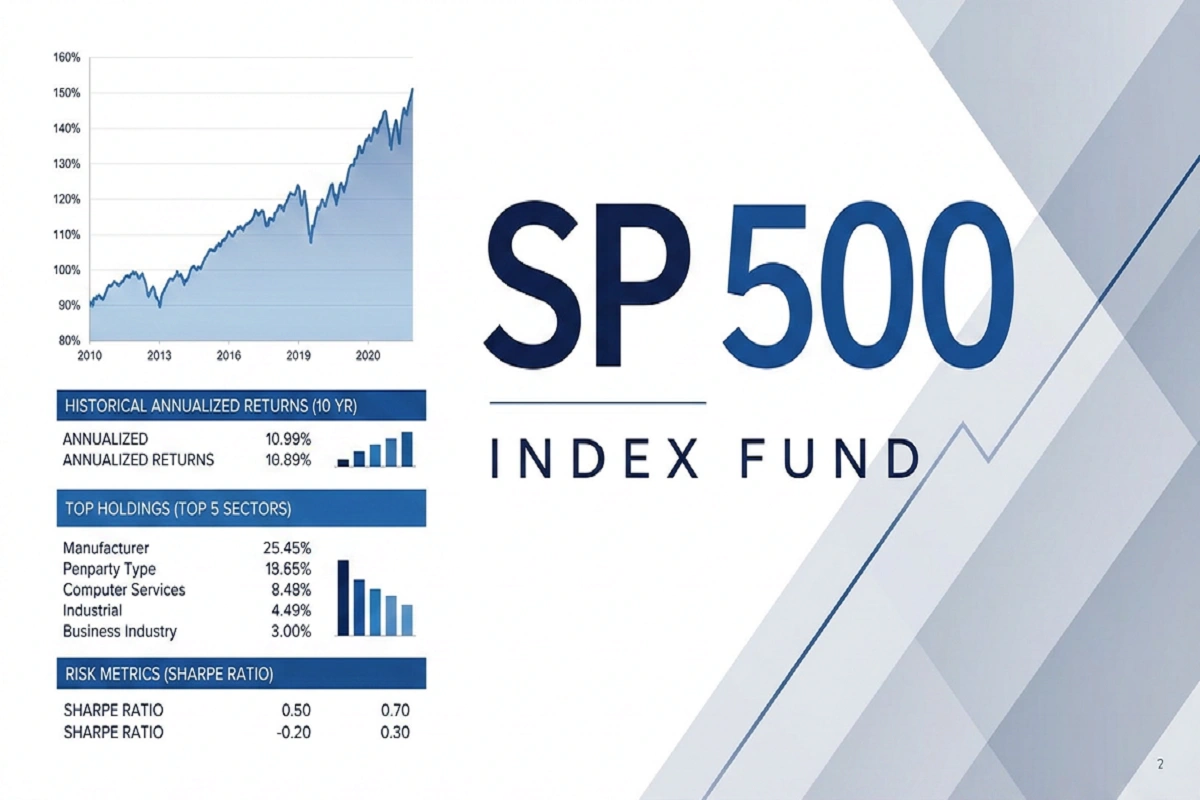
The S&P 500 has traditionally generated mean annual returns in the high single digits to low double digits over extended investment horizons, though any given year can differ drastically, including substantial drawdowns.
Simplicity
There’s no need to research distinct corporations or time the market. You buy the fund, and your job going forward is largely to maintain your market position.
Risks and Limitations to Understand
No investment is risk-free, and an SP 500 index fund is not a substitute for a fully diversified portfolio. A few limitations worth knowing before you invest:
- U.S. large-cap concentration only. The fund gives you no direct involvement to non-domestic equities, small or mid-cap U.S. companies, bonds, real property, or other asset categories. Most financial advisors advise pairing it with other assets for a diversified portfolio.
- Market-cap weighting means concentration risk. Because bigger companies carry more weight, the fund’s performance can become heavily tied to a small handful of mega-cap technology stocks in periods when those companies dominate the index.
- Volatility and drawdowns. The S&P 500 has experienced repeated downturns of 20% or more since its inception. An index fund will decline right along with the index during the slumps; there’s no manager intervening to cushion the impact.
- It’s a enduring instrument, not a short-term one. Because it moves with the market, an SP 500 index fund is typically more appropriate to investors with an extended time frame than to active trading.
Best SP 500 Index Funds to Compare
Multiple leading suppliers offer funds that monitors the identical benchmark, so the differences between them primarily depend on price, structure (mutual fund vs. ETF), and where you can buy them. Management fees and figures below are estimated and change over time — always verify the latest figures directly with the fund provider before investing.
| Fund (Ticker) | Provider | Type | Approx. Expense Ratio |
|---|---|---|---|
| Fidelity 500 Index Fund (FXAIX) | Fidelity | Mutual fund | ~0.015% |
| Vanguard S&P 500 ETF (VOO) | Vanguard | ETF | ~0.03% |
| iShares Core S&P 500 ETF (IVV) | BlackRock | ETF | ~0.03% |
| Schwab SP 500 Index Fund (SWPPX) | Charles Schwab | Mutual fund | ~0.02% |
| Vanguard 500 Index Fund (VFIAX) | Vanguard | Mutual fund | ~0.04% |
| SPDR S&P 500 ETF Trust (SPY) | State Street | ETF | ~0.095% |
All of these funds replicate the identical benchmark and hold basically the same 500 companies, so the long-range variance in returns between them tends to be small, usually driven by fee differences rather than equity picking. The more insightful inquiries are usually which brokerage you use, whether you want a mutual fund or an ETF, and whether the fund has a minimum capital threshold.
Mutual Funds vs. ETFs
Open-end funds like FXAIX, SWPPX, and VFIAX are priced once per day after markets close and are often purchased directly through the asset manager or in a pension plan with no brokerage fee. ETFs like VOO, IVV, and SPY trade throughout the day like a stock, which petitions to investors who want same-day agility or who are buying through a brokerage that doesn’t offer a specific pooled fund. Neither structure is fundamentally superior, the right choice depends on your brokerage, account type, and individual choice.
How to Buy an SP 500 Index Fund
- Open a brokerage or retirement account (a taxable brokerage account, IRA, or an employer-sponsored 401(k) that offers index fund options).
- Search for the fund by its stock ticker.
- Check the management fees, starting balance requirement, and whether the fund is accessible commission-free through your broker.
- Determine a dollar amount or share volume and submit the order.
- Evaluate setting up automated investing to build your position over time, a plan often called dollar-cost calculating.
Who Should Consider Investing in an SP 500 Index Fund?
An SP 500 index fund tends to make the most logical choice for investors with an extended time frame who want wide U.S. large-cap vulnerability at low cost, whether as an anchor retirement asset or as one piece of a balanced asset mix. It’s less appropriate as a complete stand-alone portfolio, since it omits fixed income, international stocks, and smaller U.S. companies, and it’s not designed for investors who need the money in the near term, since it can plummet during market slumps.
Because everyone’s financial standing, planning horizon, and risk appetite are different, this article is planned as general education rather than tailored financial guidance. It’s worth speaking with a certified financial planner (CFP) or doing additional research before making investment decisions, and verifying the latest management fees, minimums, and fund details directly with each provider, since these figures do change over time.
Conclusion
An SP 500 index fund remains one of the easiest, most economical methods to invest in the backbone of the U.S. stock market. By tracking 500 of the country’s largest companies, it offers immediate asset distribution, minimal fees, and a long track record that has been consistently difficult for stock-pickers to outperform. It isn’t a total portfolio on its own, and it will move with the market’s volatility, but for investors with an extended time frame looking for an uncomplicated anchor assetan SP 500 index fund is one of the most long-standing starting points in individual money management. Compare a few of the top options above, check the current management fee with the provider, and choose the fund that fits your brokerage and account type.