
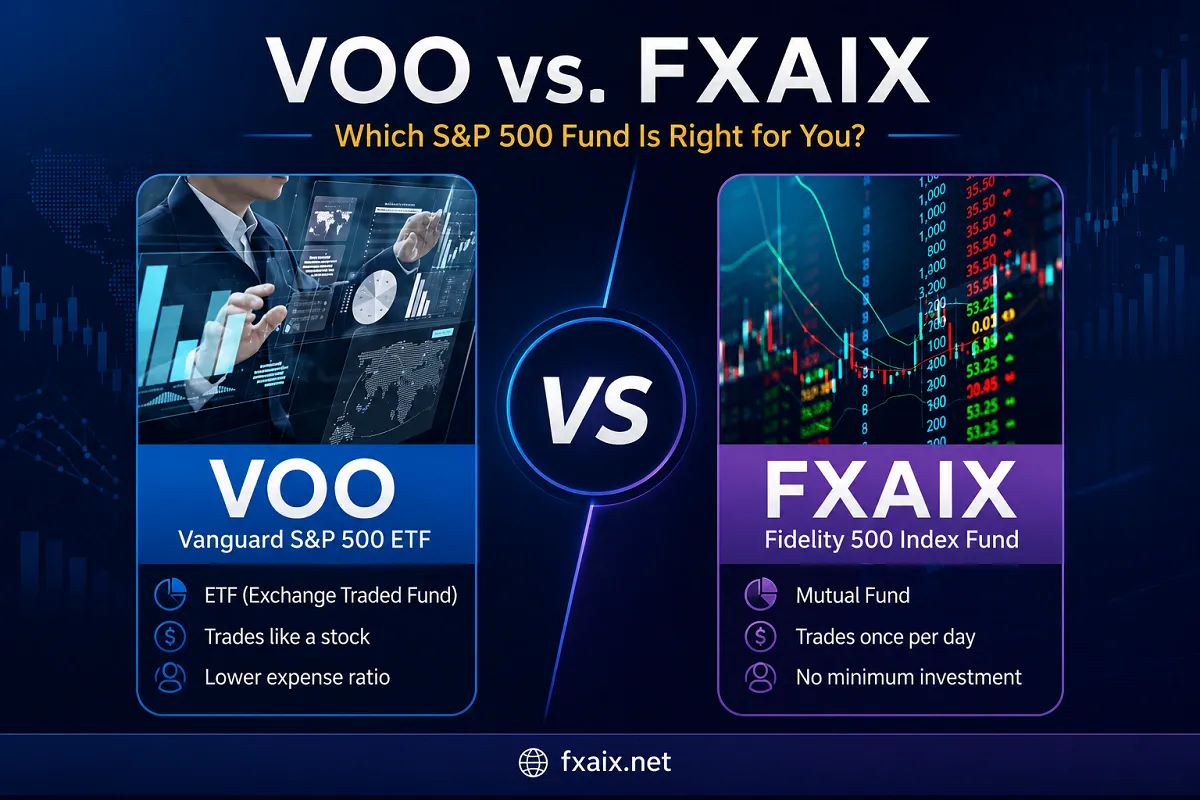
Both FXAIX and VOO guarantee the same thing: a low-cost experience for the 500 largest companies in the United States of America. They track the same index, hold the same goods in approximately the same weights, and hand over returns that are almost identical over time. So why does the FXAIX vs VOO question come up so often? Because of the small structural distinction between them, fund type, expense ratio, tax treatment, and where you can really buy them can noiselessly shape your results over years of compounding. This guide breaks down the accuracy of how the two funds differ, who each one suits, and how to choose based on your account type rather than marketing claims. All figures cited below come from each fund’s official disclosure and are current as of mid-2026.
Disclaimer: This article is for educational purposes only and is not financial advice. It does not account for your individual situation. Fund data changes over time; always confirm current figures on the fund’s official Fidelity and Vanguard fund pages before investing, and consider speaking with a licensed financial professional. (Note: this site is an independent educational resource and is not affiliated with Fidelity Investments or the FXAIX fund.)
What FXAIX and VOO Actually Are
Before comparing them, it helps to be precise about what each fund is, because the structural label drives almost every meaningful difference.
FXAIX: The Fidelity 500 Index Fund
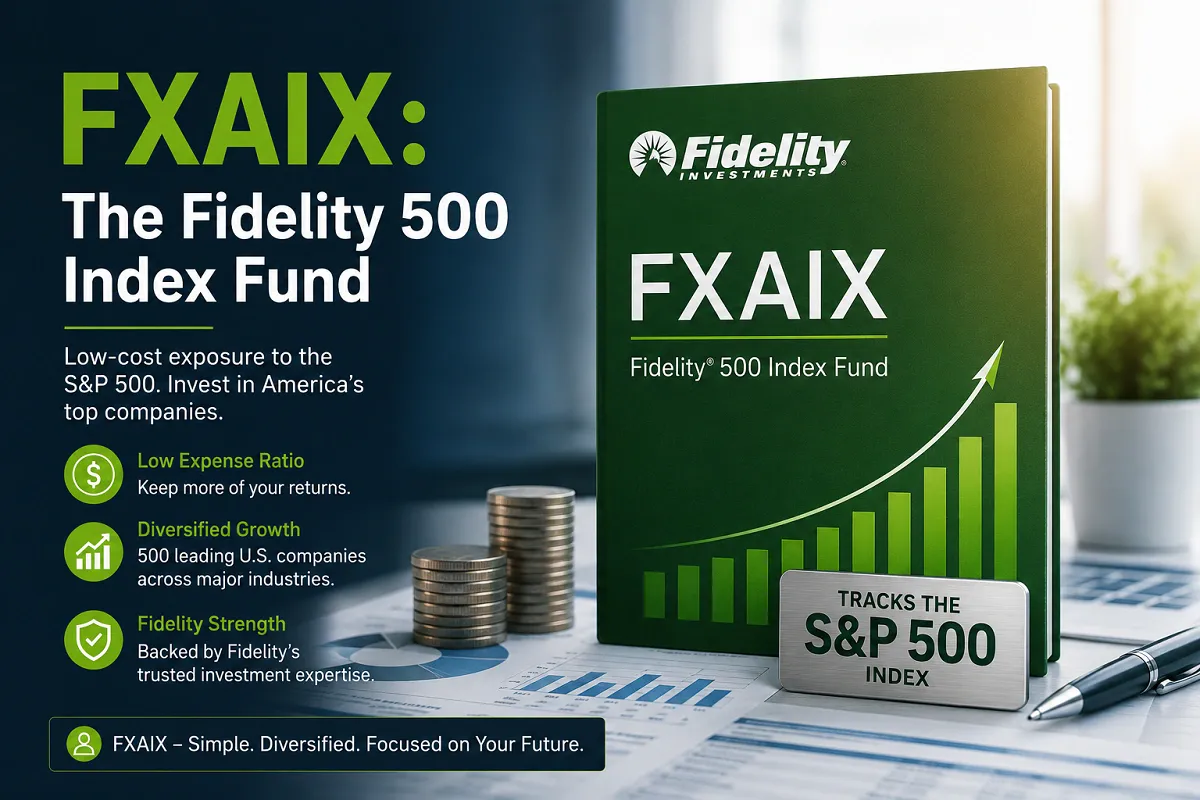
FXAIX is a mutual fund managed by Fidelity Investments that tracks the S&P 500. Like any mutual fund, it does not trade on an exchange during the day. Instead, all buy and sell orders are filled once daily at the fund’s net asset value (NAV), calculated after the market closes. FXAIX has no minimum investment, charges no transaction fee at Fidelity, and accepts purchases in exact dollar amounts, making it well-suited to automated payroll contributions and dollar-cost averaging.
The catch: FXAIX is purchasable only through a Fidelity account. You cannot buy it at Schwab, Vanguard, Robinhood, or most other brokerages.
VOO: The Vanguard S&P 500 ETF
VOO is an exchange-traded fund (ETF) from Vanguard that tracks the same S&P 500 index. As an ETF, it trades on stock exchanges throughout the day like an individual stock, so you can buy or sell at intraday market prices, set limit orders, and time your entries. VOO is available at virtually every major brokerage, which makes it portable if you ever switch platforms.
FXAIX vs VOO: The Core Differences at a Glance
| Feature | FXAIX (Fidelity 500 Index Fund) | VOO (Vanguard S&P 500 ETF) |
|---|---|---|
| Fund type | Mutual fund | ETF |
| Index tracked | S&P 500 | S&P 500 |
| Expense ratio | 0.015% | 0.03% |
| Cost per $10,000/year | ~$1.50 | ~$3.00 |
| Minimum investment | $0 | Price of 1 share |
| How it trades | Once daily at NAV | Intraday on exchanges |
| Dollar-based investing | Yes | Fractional shares at some brokers |
| Where to buy | Fidelity only | Nearly any brokerage |
| Tax efficiency (taxable accounts) | Lower | Higher |
| Best suited for | Fidelity users, tax-advantaged accounts | Taxable accounts, multi-broker investors |
The rest of this article unpacks the rows that actually move the needle.
Cost: FXAIX Is Cheaper, But the Gap Is Tiny
On paper, FXAIX wins the fee battle. Its outlay ratio is 0.015%, correctly half of VOO’s 0.03%. In dollar terms, that is nearly $1.50 per year for every $10,000 invested in FXAIX versus about $3.00 for VOO.
Both numbers are excessively low. For context, the mediocre expense ratio across the broader fund universe typically runs from 0.30% to 0.90%, so you are choosing between two of the most affordable S&P 500 vehicles available, and the difference between them amounts to about a dollar fifty per $10,000 each year.
Does the fee difference matter over time?
A little, but less than most headlines imply. On a $100,000 balance, FXAIX’s cheaper ratio saves nearly $15 a year before compounding. Over the years that compound into a modest sum, real, but small, next to factors like how much you are involved and how regularly you stay invested. The expense ratio should infrequently be the deciding factor between these two funds. Other differences, especially taxes and account access, usually have a significant impact.
Performance: Effectively a Tie
Because FXAIX and VOO track the same indicator, their returns are nearly the same, and their price movements associate at almost exactly 1.00, meaning holding both adds fundamentally no diversification.
According to Fidelity’s official periodic fund review (as of March 31, 2026), FXAIX posted final returns of nearly 17.79% over one year, 18.30% over three years, 12.05% over five years, and 14.15% over ten years, tracking the S&P 500’s own 14.16% ten-year figure almost perfectly. VOO’s long-term numbers land in the same neighborhood, with any divergence measured in basis points.
In practice, FXAIX should trail or lead VOO by no more than its tiny expense-ratio margin, and minor cash-management and tracking differences can gently push that either way in any given period. Neither fund meaningfully outperforms the other. Anyone promising a clear long-term winner on returns alone is overselling a rounding error.
Tax Efficiency: VOO’s Structural Edge
This is the difference that sincere matters for many investors, and it favors VOO.ETFs like VOO use an “in-kind” redemption and settlement procedure that allows them to flush out low-basis shares without activating taxable capital gains distributions to shareholders. As a result, VOO rarely passes capital gains down to investors. Mutual funds like FXAIX don’t have this formal process, so they can distribute taxable capital gains in some years, creating a tax bill even if you never sold a share.
What this means for you
- Taxable brokerage account: VOO’s structure can reduce unwanted taxable events, making it the more tax-efficient choice for many investors.
- Tax-advantaged account (Roth IRA, traditional IRA, 401(k)): Capital gains distributions don’t matter inside these accounts, so FXAIX’s tiny cost edge can shine without any tax drawback.
This is general information, not tax advice; your situation may differ, and a tax professional can speak to specifics.
Flexibility and Portability: VOO Travels, FXAIX Stays Home
FXAIX is locked to the Fidelity ecosystem. If you ever move your profile to another firm, you generally cannot transfer FXAIX in kind; you would have to sell it, which can activate taxes in a taxable account. VOO, being a widely held ETF, transfers cleanly between mediators and trades anywhere.
VOO also gives you day trading control limit orders, stop orders, and the ability to react to price during market hours. FXAIX fills only once a day at the closing NAV. For long-term, buy-and-hold investors, that once-a-day mechanic is a non-issue and arguably a feature; it removes the inducement to trade. For anyone who values precise timing or broker portability, VOO has the margin.
How to Choose Between FXAIX and VOO
There is no universally “better” fund, only the better fit for your situation. A practical way to decide:
Lean toward FXAIX if you:
- Invest primarily through Fidelity
- Hold the fund in a tax-advantaged account (IRA, 401(k))
- Want to invest exact dollar amounts and automate contributions
- Prefer a hands-off, once-a-day vehicle with no intraday temptation
Lean toward VOO if you:
- Use a non-Fidelity brokerage, or want to keep your options open
- Are you investing in a taxable account where tax efficiency matters
- Value intraday trading, limit orders, or broker portability
- Want a fund you can carry across platforms without selling
For many long-term investors, the honest answer is: pick the one that matches your account, and don’t agonize over it. Both are excellent, low-cost ways to own the S&P 500, and switching costs (especially taxes) often outweigh the marginal benefit of chasing the “optimal” choice.
Final Words
The FXAIX vs VOOdebatel is definitely a debate between two nearly-same funds separated by structure, not substance. FXAIX wins closely on cost and suits Fidelity users and tax-advantaged accounts. VOO wins on tax effectiveness, flexibility, and portability, making it the powerful pick for taxable accounts and investors who want to move freely between brokerages.
Both track the same 500 companies, both charge a fraction of what active funds cost, and both will deliver essentially the same long-term market return. The smartest move is to match the fund to your account type and your platform, then let compounding do the work, rather than overthinking a difference that, for most people, amounts to a dollar or two per ten thousand invested each year. No matter which you choose, you are owning the U.S. large-cap market at a rock-bottom cost, which is perfectly the goal.
Frequently Asked Questions
Is FXAIX or VOO better for a Roth IRA?
Inside a Roth IRA, capital gains allocations are not taxable, so VOO’s tax-effectiveness advantage disappears. That makes FXAIX’s gradually lower 0.015% expense ratio mildly charming, but only if you hold the IRA at Fidelity. If your Roth IRA is at another mediator, VOO is the natural choice. The practical difference between them in a Roth is the smallest.
Can I buy FXAIX outside of Fidelity?
Generally no. FXAIX is a Fidelity interchangeable fund and is typically purchasable only through a Fidelity account. If you invest at Schwab, Vanguard, Robinhood, or another broker, VOO (or that broker’s own S&P 500 fund) is the reachable alternative.
Why is VOO considered more tax-efficient than FXAIX?
VOO is an ETF, and ETFs use an in-kind redemption process that lets them avoid passing taxable capital gains to shareholders. FXAIX, as a mutual fund, lacks that process and can allocate capital gains in some years. In a taxable account, this can make VOO the more tax-friendly option; in a tax-favored account, the difference is not connected.
Do FXAIX and VOO have the same holdings?
Successfully yes. Both track the S&P 500 and hold the same nearly 500 large-cap U.S. companies, names like Apple, Microsoft, NVIDIA, Amazon, and Alphabet at the top, ranked by market capitalization. Their association is fundamentally 1.00, so owning both provides almost no added expansion.
Is the expense ratio difference between FXAIX and VOO significant?
Not really. FXAIX charges 0.015%, and VOO charges 0.03%, a gap of about $1.50 per year per $10,000 invested. Both are among the most affordable S&P 500 funds obtainable. The fee difference is real but small,l sufficient that tax treatment and account access often matter more.
Should I own both FXAIX and VOO?
Generally, there is a minor reason to. Because they track the same indicator and move almost uniformly, holding both fundamentally doubles your position in the same market portion without introducing variety. Most investors are better served by choosing one based on their account and stockbroker.
For any suggestions or changes, please get in touch with us.