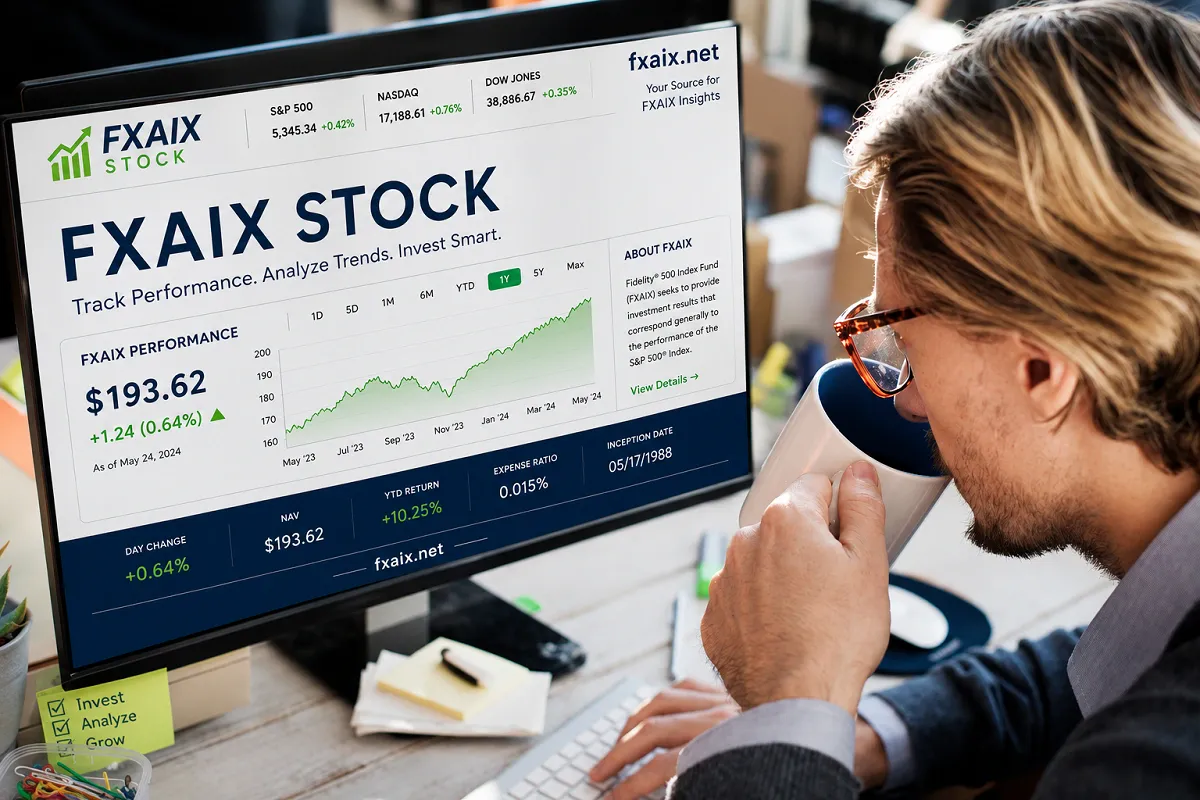
If you looked up “FXAIX stock,” you should know that FXAIX is not a stock. FXAIX is actually the symbol for the Fidelity 500 Index Fund. This fund is one of the cheapest index mutual funds in the United States. People search for “FXAIX stock” because the symbol FXAIX looks like a stock symbol and works like one. It is really a mutual fund. This makes a difference in how you buy it, how much it costs, and where you put it in your investments. This guide will explain everything about FXAIX in terms. You will learn what the Fidelity 500 Index Fund actually is, what it invests in, how its low fees work, how well it has done, and how it is different from other investments like VOO and IVV. You will also learn how to buy the Fidelity 500 Index Fund and what the limits are. The numbers in this guide are based on data from mid-2026, so you should always check the numbers on Fidelity’s website before you invest in the Fidelity 500 Index Fund.
Disclaimer: This article is for learning. Is not advice on what to do with your money. The Fidelity 500 Index Fund did well in the past. That does not mean the Fidelity 500 Index Fund will be good in the future. You should talk to an expert who can give you advice about the Fidelity 500 Index Fund. The expert can tell you if the Fidelity 500 Index Fund is right for you and your situation, and help you decide on the Fidelity 500 Index Fund.
What Is FXAIX?
The Fidelity 500 Index Fund, also known as FXAIX, is a fund that Fidelity Investments started on May 10 2011. It is an investment. The main goal of the Fidelity 500 Index Fund, or FXAIX, is to follow the S&P 500 Index. This index is a list of companies in the United States. People can sell stocks in these S&P 500 companies. The Fidelity 500 Index Fund helps people invest in the S&P 500 Index. The Fidelity 500 Index Fund is an investment choice. It has 500 companies on it. These companies are chosen based on how they are worth. The Fidelity 500 Index Fund, or FXAIX, has a lot of these companies in it. In fact, it has all of the same companies as the S&P 500 Index.
It tries to have them in the proportions, too. The Fidelity 500 Index Fund does not have a manager who tries to pick the companies or figure out when to buy and sell. This helps keep costs low for the Fidelity 500 Index Fund, also known as FXAIX. By the middle of 202,6 the Fidelity 500 Index Fund or FXAIX had around $790 to $832 billion in it. This makes the Fidelity 500 Index Fund one of the index funds in the world. The Fidelity 500 Index Fund, also called FXAI, is really big. These companies are weighted by how they are valued on the market.
All these companies together make up 80 percent of the total value of the US stock market. Because it’s a passively managed index fund, no manager is picking winners or timing the market. FXAIX holds the companies as the S&P 500 in almost the same proportions. This helps keep costs low. As of mid-2026, FXAIX has around $790-832 billion in assets. It is one of the index funds in the world.
Stock vs. Mutual Fund: Why the Difference Matters
A stock is a share of one company. A mutual fund like FXAIX is a single basket holding hundreds of stocks at once. That difference has real consequences:
- Diversification. Buying FXAIX gives you a slice of ~500 companies in one purchase, instead of betting on a single firm.
- Pricing. A stock trades continuously during market hours at a live price. FXAIX is priced once per day at its net asset value (NAV), calculated after the 4 p.m. ET market close.
- How orders fill. You cannot set a price limit for buying or selling FXAIX during the day. Any order you place will be done at the closing price of that day.
When people say “FXAIX stock price,” they are referring to the fund’s price. The price of the FXAIX fund was around $257 for 1 share in June 2022.
Top Holdings (Approximate Weights, Mid-2026)
The largest positions typically include:
| Company | Approx. Weight |
|---|---|
| NVIDIA | ~7–8% |
| Apple | ~6–7% |
| Microsoft | ~5% |
| Amazon | ~4% |
| Alphabet (Google) | ~3–4% |
| Meta Platforms | ~2–3% |
| Broadcom | ~2% |
| Berkshire Hathaway | ~2% |
| Tesla | ~1–2% |
| JPMorgan Chase | ~1–2% |
The top 10 holdings of the fund account for 38 percent of the fund. The weights of the 10 holdings of the fund change all the time because the prices of shares go up and down, and S&P Global changes the index,x, so the ranking of the top 10 holdings of the fund is, like a picture of what it looks like right now, ow not a list that stays the same forever.
Sector Breakdown
The FXAIX fund has all 11 GICS sectors in.t.. The FXAIX fund is mostly made up of technology. This is around 28 to 32 percent of the FXAIX fund. The FXAIX fund also has a lot of financials, health care, re and consumer discretionary. The FXAIX fund is set up this way because of the S&P 500. The S&P 500 is like this; it is not something the FXAIX fund decided to do. It is an idea to know this about the FXAIX fund. The reason is that the FXAIX fund will go up and down with the technology sector. This is because the FXAIX fund has a lot of technology in it.
The Expense Ratio: Why FXAIX Is So Cheap
The headline reason investors choose FXAIX is cost. The cost of this investment is really low. It is 0.015 percent. This means that for every 10,000 dollars you put in, you pay one dollar and fifty cents per year. Some people who collect data say it is 0.01 percent or 0.02 percent. Fidelity says it is 0.015 percent. This fee is one of the fees of any S&P 500 fund that exists. For example, let the Vanguard S&P 500 fund and the iShares Core S&P 500 fund both charge 0.03 percent. That is double what the Fidelity S&P 500 fund charges.
Why is this information important about the S&P 500 fund?
Fees compound against you over time. Because FXAIX skims so little, nearly every dollar of index return flows through to you. Over a multi-decade holding period, that difference can add up to thousands of dollars.
FXAIX Performance and Dividends
FXAIX is designed to match the S&P 500’s return, not beat it. As of mid-2026, reported trailing returns looked roughly like this:
- YTD: ~8.7%
- 1-year: ~25.8%
- 3-year average: ~22.5%
- 5-year average: ~14.0%
These numbers reflect a strong recent run for U.S. large-cap stocks and should not be read as expected future returns. Index funds are fully exposed to market downturns; when the S&P 500 falls, FXAIX falls with it.
Dividends
FXAIX gives a dividend yield of around 1.0%. It distributes this dividend every quarter. It also distributes capital gains annually. When you hold FXAIX in a 401(k) or IRA, the distributions get reinvested. You do not have to pay taxes on them. In a brokerage account, FXAIX works a bit differently. It is a fund. Mutual funds sometimes pass on capital gains to the investor. This can make it a bit less tax-friendly compared to an ETF. ETFs usually do not pass on these capital gains.
How to Buy FXAIX (and the Catch)
Here’s the practical limitation that surprises many investors: FXAIX is a Fidelity proprietary fund. You generally can’t buy it at Schwab, Vanguard, Robinhood, or most other brokerages. To own it, you typically need a Fidelity account. The upside for Fidelity customers is genuinely friendly terms:
- No minimum investment, you can buy in exact dollar amounts, down to the penny.
- No transaction fee within Fidelity.
- Well-suited to automated payroll contributions and dividend reinvestment, which makes it a natural 401(k) and IRA core holding.
The trade-off is portability: if you ever move to another brokerage, transferring FXAIX usually forces a sale, which can trigger taxes in a non-retirement account.
FXAIX vs. VOO vs. FSKAX: Quick Comparison
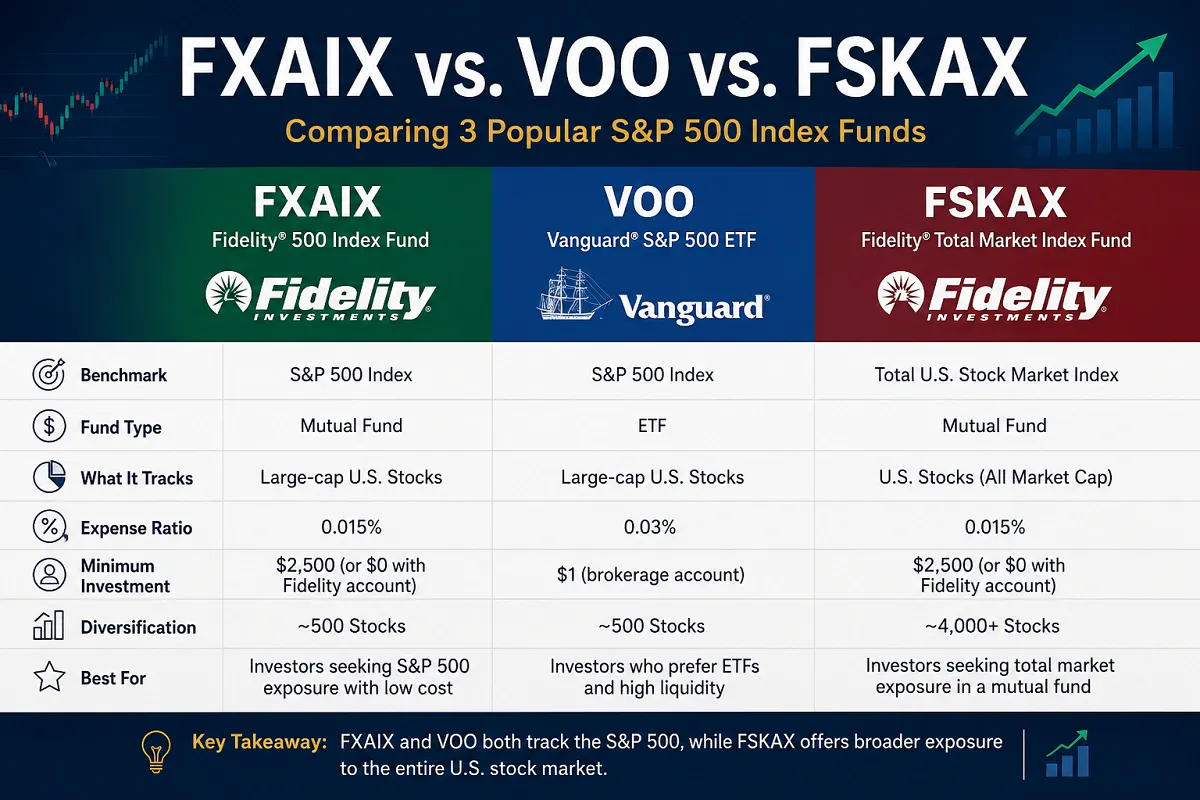
A few funds are commonly weighed against FXAIX:
- FXAIX vs. VOO/IVV: Nearly identical S&P 500 exposure. FXAIX is cheaper (0.015% vs. 0.03%) but is a Fidelity-only mutual fund; VOO and IVV are ETFs that trade anywhere intraday and tend to be more tax-efficient in taxable accounts.
- FXAIX vs. FSKAX: FSKAX is Fidelity’s total U.S. market index fund; it includes mid- and small-cap companies on top of the S&P 500 large caps. Choose FSKAX for broader coverage, FXAIX for pure large-cap S&P 500 exposure.
The right pick depends on your account type and whether you value the lowest fee (FXAIX) or cross-brokerage flexibility and tax efficiency (VOO/IVV).
Who Is FXAIX Best For?
FXAIX tends to fit:
- Fidelity account holders who want simple, low-cost S&P 500 exposure.
- Retirement savers in 401(k)s and IRAs, where the mutual-fund structure’s minor tax drawbacks don’t apply.
- Long-term, hands-off investors are comfortable with a buy-and-hold core holding of roughly 30–70% of a portfolio.
It’s a weaker fit for active traders (no intraday trading), investors who want brokerage portability, or anyone in a taxable account who would prefer an ETF’s tax treatment.
FAQs:
Is FXAIX a stock?
No. FXAIX is the ticker for the Fidelity 500 Index Fund, a mutual fund that holds about 500 stocks. It’s priced once daily at NAV, not traded live like an individual stock.
What is the FXAIX stock price today?
FXAIX doesn’t have a live “stock price.” Its NAV is calculated once after the 4 p.m. ET close and was around $257 per share in early June 2026. Check Fidelity for the current figure.
Can I buy FXAIX outside of Fidelity?
Usually not. FXAIX is a Fidelity proprietary mutual fund and generally isn’t available at Schwab, Vanguard, or Robinhood. Investors at other brokerages often choose VOO or IVV instead for the same S&P 500 exposure.
What is the FXAIX expense ratio?
About 0.015%, or roughly $1.50 per year per $10,000 invested, one of the lowest of any S&P 500 fund.
Does FXAIX pay dividends?
Yes. It pays a dividend yield of about 1.0%, distributed quarterly, with capital gains typically distributed once a year.
Is FXAIX a good investment?
It really depends on what you want to do with your money and the kind of account you have . If you want to own a bit of all the big companies in the S&P 5,00 FXAIX is an option.FXAIX is cheap. It gives you a chance to own a little bit of all the big companies in the S&P 500. You have to remember that.
Final Words
The most useful thing is the one we started with: When you think about it, everything else is pretty simple. The Fidelity Zero Large Cap Index Fund is priced one day at its net asset value. It has about 500 of the biggest companies in the United States, and it follows the S&P 500 index with a very low cost of 0.015 percent. For people who invest with Fidelity and want to build a long-term investment that’s low-cost and stable, the Fidelity Zero Large Cap Index Fund is a very good way to own a part of the large companies in the United States. You just need to remember that it only trades at the end of the day,y when the net asset value is s. It is only available through Fidelity. The Fidelity Zero Large Cap Index Fund has the same risks as the S&P 500 index. You should check Fidelity’s website to see the price of the Fidelity Zero Large Cap Index Fund.The returns of this fund and its costs are also available there. Then you can compare the Fidelity Zero Large Cap Index Fund with exchange-traded funds, like the Vanguard S&P 500 ETF and the iShares Core S&P 500 ETF. This way,y you can get an understanding of the Fidelity Zero Large Cap Index Fund and make a more informed decision. You may also want to look at how the Fidelity Zero Large Cap Index Fund performs compared to the Vanguard S&P 500 ETF and the iShares Core S&P 500 E TF. This will help you decide on the Fidelity Zero Large Cap Index Fund.
For any suggestions or changes, please contact us.