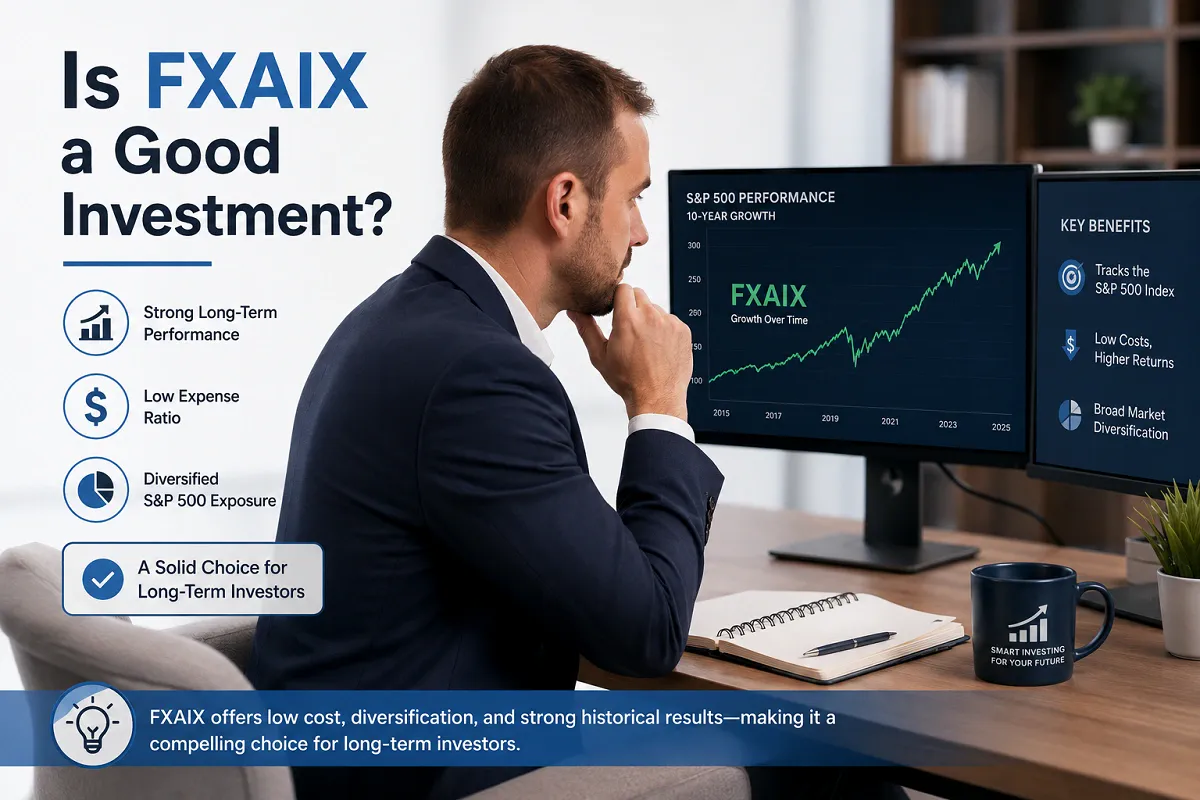
If you’re deliberating about investing in the US stock market, you’ve most likely heard of FXAIX. The Fidelity 500 Index Fund, known by the ticker symbol FXAIX, is one of the biggest and most important index funds in the United States. The fund follows the S&P 500 Index, which involves the 500 biggest and most important companies in the United States. But the real question is: Is FXAIX really a good investment? In this article, we’ll take a closer look at Is FXAIX a Good Investment? the fund’s fees, performance, benefits, risks, and alternatives so you can make a better decision.
FXAIX Fees and Expenses
The most important aspect of FXAIX is its incredibly low expense ratio of just 0.015%. This means that if you invest $10,000, you will pay only $1.50 in fees per year. This is less than Vanguard’s VOO (0.03%) and iShares’ IVV (0.03%).
In addition, FXAIX has no minimum investment requirement; you can start with as little as $1. There are also no-load fees, redemption fees, or transaction fees. These features make it a great choice for both new and experienced investors.
FXAIX Historical Performance
It is important to look at past performance when evaluating any fund, although it is not a guarantee of future performance. FXAIX has shown remarkable results over various periods:
Overview of Profits (2026 data)
- Year-to-date (YTD) profit: Nearly 10.20%
- One-year profit: Nearly 25-30%
- Three-year average annual profit: Nearly 22.5%
- Five-year average annual profit: Nearly 14%
- Ten-year average annual profit: Nearly 15.63%
Morningstar has ranked this fund 5 out of 5 stars, indicating the best risk-adjusted performance among its peer group. The dividend yield is nearly 1%, and dividends are paid quarterly.
Benefits of Investing in FXAIX
Diversification
You get an easy approach to over 500 of the largest U.S. companies in a single fund. The funds are distributed across 11 major sectors, including technology, healthcare, financials, consumer, and energy.
Extremely low cost
An expense ratio of 0.015% makes it one of the most important and economical S&P 500 funds accessible on the market. Low fees, almost non-existent, mean higher returns for you in the long run.
Easy access and simplicity
No minimum investment, purchases are possible in exact dollar amounts, and automatic dividend reinvestment is also available. This is ideal for dollar-cost averaging.
Fidelity Trust
Fidelity Investments is one of the largest and oldest financial services companies in the United States. This brand reputation provides confidence in the management of the fund.
Potential Risks and Limitations of FXAIX
Market Risk
FXAIX invests 100% in stocks and has no capital preservation. The fund saw a decline of about 18% in the 2022 bear market, and the S&P 500 lost more than 50% of its value during the 2008 financial crisis. This means that the potential for losses during a downturn is very high.
Overexposure to the technology sector
Currently, about 31% of the fund is in the technology sector alone. This means that if there is a major crisis in the tech industry, FXAIX will be more affected than expected.
Only available at Fidelity
FXAIX can only be purchased through a Fidelity brokerage account, not elsewhere. If you are on Robinhood, Schwab, or another platform, you will need to look at ETF alternative funds like VOO or IVV.
Lack of international diversification
This fund focuses only on US large-cap companies. It does not include international stocks, small-cap companies, or bonds. You will need to combine it with other funds for a complete portfolio.
FXAIX vs. VOO and SPY, Which is better?
All three funds track the same index, the S&P 500, and their long-term performance is approximately the same. The distinction lies in their structure:
- FXAIX: Mutual fund, trades at NAV at the end of the day, available only at Fidelity, expense ratio 0.015 percent
- VOO (Vanguard): ETF, trades throughout the day, available at any brokerage, expense ratio 0.03 percent
- SPY (SPDR): ETF, most liquid, popular with active traders, expense ratio 0.0945 percent
If you are a Fidelity account holder, especially within a 401(k) or IRA, FXAIX is generally the best choice because the tax differences are irrelevant there. VOO or IVV may be better for a taxable account because ETFs typically have fewer taxable events.
What type of investor is FXAIX suitable for?
FXAIX is a set-it-and-forget-it type of investment. It is best for those who:
- Seek long-term wealth creation. (10 years or more)
- Prefer passive investing.
- Already have or plan to open an account with Fidelity.
- Are you looking for a core holding in a retirement account? (401k/IRA)
- Value low fees and broad market exposure.
FAQs:
Q: Is FXAIX a safe investment?
A: FXAIX is a stock fund, so it does carry market risk. However, its diversification across the 500 largest companies and management by a reputable institution like Fidelity make it safe. It is not FDIC underwritten. In the long term, the S&P 500 has performed well, but short-term losses can happen.
Q: What is the difference between FXAIX and VOO?
A: Both follow the S&P 500 and usually have the same performance. The main distinction is that FXAIX is a mutual fund, so you can buy or sell it only at the end of the trading day. VOO is an ETF, so you can buy or sell it anytime during the trading day. FXAIX has a marginally lower expense ratio (0.015 vs. 0.03 percent), but it is only accessible at Fidelity.
Q: Is FXAIX good for beginning investors?
A: Absolutely. No minimum investment, very low fees, and wide diversification; all three of these features make FXAIX a great choice for beginners. You can start with just a few dollars by opening a Fidelity account. You can even start with as little as one dollar.
Q: Does FXAIX pay dividends?
A: Yes, FXAIX pays a quarterly dividend. The current dividend yield is about 1%. With a Fidelity account, you can opt for automatic reinvestment of dividends, which helps compound growth over the long term.
Q: What happens to FXAIX in a market crash?
A: Since FXAIX is comprised entirely of stocks, its value also falls in a market crash. Although the market can fall, the S&P 500 has recovered from every major downturn in the past. Temporary declines should generally not be a cause for concern for long-term investors, as long as they stay invested.
Q: Is FXAIX good for retirement?
A: FXAIX is commonly suggested as a core holding for retirement accounts like 401(k)s and IRAs. In these tax-advantaged accounts, the tax distinctions between mutual funds and ETFs become inapplicable, and FXAIX’s low fees and broad liability make it a solid foundation for retirement planning.
Summary
FXAIX is a low-cost, broad-based fund that tracks the performance of the S&P 500 very successfully. Its 0.015% expense ratio, zero minimum investment, and Morningstar 5-star rating make it an important choice for long-term passive investors, particularly Fidelity account holders.
However, it is important to understand that FXAIX is not a complete portfolio in itself. It does not involve international exposure, small-cap, or bonds. Also, every investment carries risk, and past performance is not a guarantee of future results. Please review your financial objectives, risk tolerance, and time horizon before making any investment decisions, and consult a qualified financial advisor if necessary.
Disclaimer
This article is for educational and informational purposes only and is not financial advice. Investment decisions are based on your personal financial situation. Ask a qualified financial advisor for advice before you make any investment.
For any suggestions or changes, please feel free to contact us.