For millions of investors, the simplest path to owning a slice of the American economy runs through a single five-letter ticker: FXAIX. It is one of the most widely held index funds in the world, and for good reason. But “popular” and “right for you” are not the same thing. This guide breaks down exactly what FXAIX is, how it has performed, what it holds, what it costs, and where it fits- and doesn’t fit- in a real portfolio. The goal is to give you the full picture so you can decide with confidence rather than hype.
What Is FXAIX?
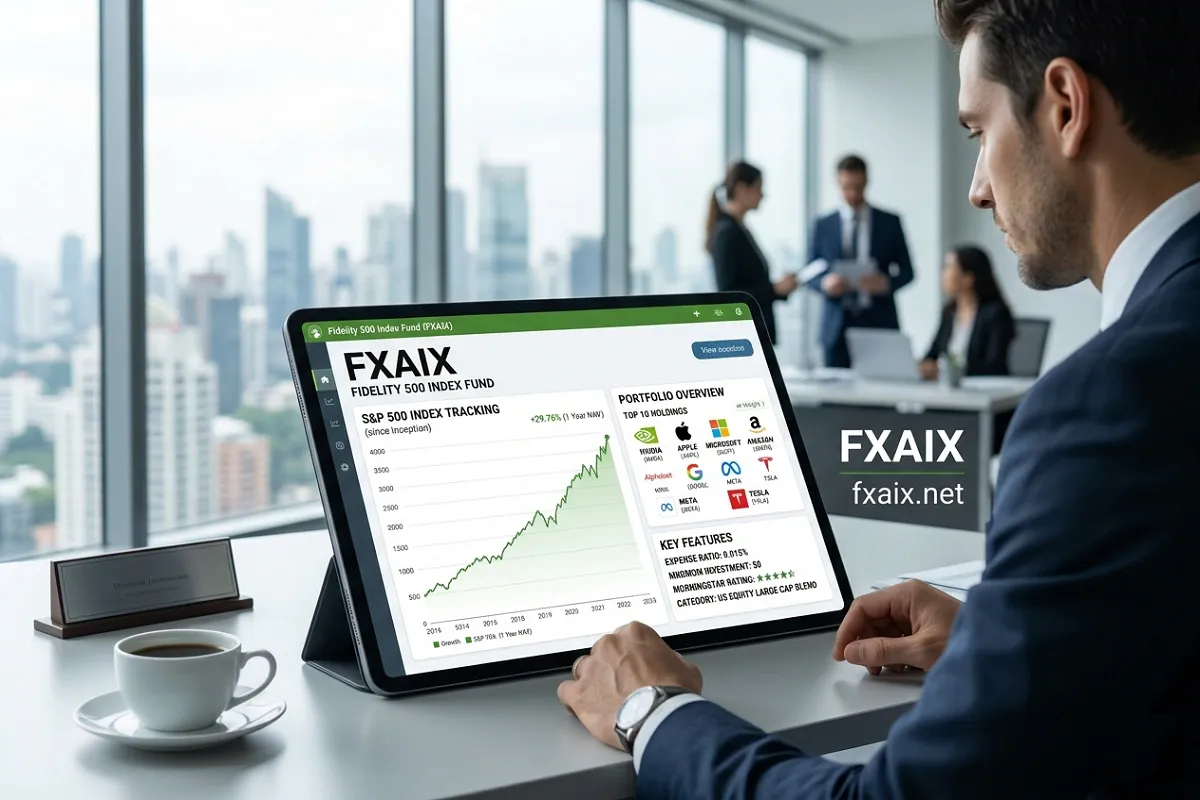
FXAIX is the ticker symbol for the Fidelity 500 Index Fund, a passively managed mutual fund designed to track the S&P 500 Index. When you buy a share of FXAIX, you are effectively buying a tiny, proportional stake in roughly 500 of the largest publicly traded companies in the United States, names like Nvidia, Apple, Microsoft, Amazon, and Alphabet.
The S&P 500 itself is maintained by S&P Global and represents about 80% of the total value of the U.S. stock market. Rather than researching and buying hundreds of individual stocks, an FXAIX shareholder gets that broad exposure in a single transaction. The fund is sub-advised by Geode Capital Management and stands as one of Fidelity’s flagship index products, with more than $790 billion in assets, placing it among the largest funds of any kind globally.
One detail that trips up new investors: it is a mutual fund, not an exchange-traded fund (ETF). That distinction shapes how you buy it, how it’s taxed, and where it makes the most sense to hold it, points we’ll return to below.
How FXAIX Works
FXAIX uses a straightforward replication strategy. There are no star managers picking winners, no factor tilts, and no attempts to beat the market. The fund simply holds the companies in the S&P 500 in roughly the same weights as the index, so its return closely mirrors the index minus a very small fee.
Because it is a mutual fund, it trades only once per day, at the net asset value (NAV) calculated after the market closes at 4 p.m. Eastern. You cannot buy or sell it intraday, set a limit price, or watch its price tick during the trading day. In exchange, you get something ETFs can’t easily match: the ability to buy in exact dollar amounts down to the penny, which makes it ideal for automated payroll contributions and dividend reinvestment.
FXAIX at a Glance
| Feature | Detail |
|---|---|
| Fund name | Fidelity 500 Index Fund |
| Ticker | FXAIX |
| Fund type | Open-end mutual fund |
| Index tracked | S&P 500 |
| Expense ratio | 0.015% (sometimes shown as 0.02%) |
| Minimum investment | $0 |
| Net assets | Over $790 billion |
| Holdings | ~505 stocks |
| Dividend frequency | Quarterly |
| Sub-advisor | Geode Capital Management |
Figures current as of mid-2026; always confirm the latest on Fidelity’s official fund page.
FXAIX Performance: What the Numbers Show

FXAIX is built to match the S&P 500, so its track record is essentially the index’s track record, less the tiny expense ratio. As of mid-2026, the fund’s recent returns looked like this:
- Year-to-date: roughly 8.7%
- 1-year: roughly 25.8%
- 3-year average (annualized): roughly 22.5%
- 5-year average (annualized): roughly 14.0%
- 10-year average (annualized): roughly 15.5%
Those are strong numbers, but context matters more than the headline figures.
Putting Performance in Context
The past several years have been an unusually powerful stretch for U.S. large-cap stocks, driven heavily by a handful of mega-cap technology companies. A 22% three-year annualized return is well above the long-run historical average for the S&P 500, which has delivered closer to 10% per year (before inflation) across many decades. Recency can be misleading: strong trailing returns do not predict future results, and the same concentration that has boosted FXAIX recently could amplify losses in a downturn. During the 2022 bear market, for instance, the fund fell by roughly a third from its peak.
The takeaway isn’t that it is a poor investment; it’s that you should expect volatility and plan for years when the fund declines, sometimes sharply. Index investing rewards patience, not timing.
What’s Inside FXAIX? Holdings and Sector Breakdown
Because FXAIX is market-cap weighted, the biggest companies make up the biggest share of the fund. That has important implications for risk and diversification.
Top Holdings
As of mid-2026, the fund’s largest positions were concentrated in mega-cap technology and communication names:
| Company | Approx. weight |
|---|---|
| Nvidia | 7.9% |
| Apple | 6.5% |
| Microsoft | 4.9% |
| Amazon | 4.2% |
| Alphabet (Class A & C combined) | ~6.5% |
| Broadcom | 3.2% |
| Meta Platforms | 2.2% |
| Tesla | 1.7% |
| Berkshire Hathaway | 1.4% |
The top 10 holdings together account for roughly 36–38% of the entire fund.
Sector Allocation
By sector, technology dominates, reflecting its outsized role in today’s market:
- Technology: ~36%
- Financial Services: ~12%
- Communication Services: ~11%
- Consumer Cyclical: ~10%
- Healthcare: ~9%
- Industrials: ~8%
- Everything else (Consumer Defensive, Energy, Utilities, Real Estate, Materials): ~14% combined
The Concentration Question
Here is something many investors overlook: although FXAIX holds about 500 companies, it is far more concentrated than that number suggests. With more than a third of the fund sitting in its 10 largest holdings, and roughly a third in technology alone, FXAIX’s fortunes are closely tied to a small group of mega-cap stocks. When those companies thrive, the fund soars. When they stumble, the broad “500-stock diversification” offers less protection than you might expect. This isn’t a flaw in the fund; it is simply how a market-cap-weighted index works. But it is worth understanding before you assume FXAIX is fully diversified.
FXAIX Costs and Fees
Cost is where FXAIX genuinely shines. The fund’s expense ratio is just 0.015%, meaning you pay about 15 cents per year for every $1,000 invested. (Some data providers round this to 0.02%, but Fidelity’s prospectus lists 0.015%.) There is no minimum investment, no transaction fee when bought at Fidelity, and no sales load.
To put that in perspective: on a $100,000 balance, FXAIX’s annual fee comes to roughly $15. The category average for similar large-blend funds is many times higher, and actively managed funds often charge 0.5% to 1.0% or more — costs that compound into tens of thousands of dollars in lost returns over a lifetime of investing. At FXAIX’s price, fees are effectively a rounding error, which is exactly what you want from a core holding.
FXAIX vs. the Alternatives
FXAIX is excellent, but it isn’t the only way to own the S&P 500. The right choice often depends less on the fund itself and more on which brokerage you use. Buying a fund outside its home brokerage can trigger transaction fees that wipe out years of expense-ratio savings, so “buy at home” is a sensible default.
| Fund | Type | Expense ratio | Best for |
|---|---|---|---|
| FXAIX | Mutual fund | 0.015% | Fidelity investors |
| VFIAX | Mutual fund | 0.04% | Vanguard investors |
| VOO | ETF | 0.03% | ETF fans, taxable accounts, any broker |
| SWPPX | Mutual fund | 0.02% | Schwab investors |
| FNILX | Mutual fund | 0.00% | Fidelity loyalists (tracks a proprietary index) |
FXAIX vs. VOO
VOO is Vanguard’s S&P 500 ETF. The two are nearly identical in holdings and performance; over the past decade, their annualized returns have differed by a hair. The real differences are structural: VOO trades intraday like a stock and tends to be more tax-efficient in taxable accounts, while FXAIX offers dollar-based investing and daily NAV simplicity. For a Fidelity 401(k) or IRA, it is usually the path of least resistance.
FXAIX vs. VFIAX
VFIAX is Vanguard’s S&P 500 mutual fund and FXAIX’s closest equivalent. It is slightly cheaper (0.015% vs. 0.04%) and has no minimum, while VFIAX requires a $3,000 minimum. For a Vanguard account holder, VFIAX makes sense; for everyone else, FXAIX is the more accessible option.
FXAIX vs. FNILX
FNILX is Fidelity’s “ZERO” large-cap fund with a 0.00% expense ratio. The catch: it tracks a Fidelity proprietary index rather than the official S&P 500, and it cannot be transferred to another broker. For investors certain they’ll stay at Fidelity, the savings are real but tiny; for everyone else, FXAIX’s true S&P 500 tracking and portability usually make it the safer default.
Who Should Consider FXAIX?
FXAIX is designed to be a core holding, the foundation of a portfolio rather than a tactical bet.
A Strong Fit For…
FXAIX tends to suit long-term, buy-and-hold investors who already use Fidelity, especially inside tax-advantaged accounts like 401(k)s and IRAs, where its mutual-fund tax quirks don’t matter. It’s an excellent choice for retirement savers making automatic contributions, beginners who want broad market exposure without picking stocks, and anyone seeking a low-cost anchor for a diversified portfolio.
When to Look Elsewhere
FXAIX may be less ideal if you invest through a taxable brokerage account and prioritize tax efficiency (where an ETF like VOO can have an edge), if you want to trade intraday or use limit orders, or if you value the ability to move holdings between brokerages without selling. International exposure is another gap; FXAIX is 100% U.S. stocks, so most investors will want to pair it with international and bond funds for true diversification.
How to Invest in FXAIX
Buying FXAIX is straightforward, especially if you already have a Fidelity account:
- Open or log in to a Fidelity brokerage, IRA, or 401(k) account.
- Search for the ticker FXAIX.
- Enter the dollar amount you want to invest (there’s no minimum).
- Place the order, and it will execute on that day’s closing NAV.
- Set up automatic recurring investments to dollar-cost average over time.
If your retirement plan or brokerage doesn’t offer FXAIX, a comparable S&P 500 fund such as VOO, VFIAX, or SWPPX can fill the same role. The specific fund matters far less than consistently investing and staying the course.
Risks and Drawbacks to Understand
No investment is risk-free, and FXAIX is no exception.
Market Risk
FXAIX rises and falls with the S&P 500. In a market downturn, it will decline, potentially by 30% or more, as it did in 2022. Anyone investing in FXAIX should be prepared to hold through volatility and avoid panic-selling at the bottom.
Concentration Risk
As discussed, the fund’s heavy weighting toward a handful of mega-cap tech stocks means its performance is increasingly tied to that narrow group. A sharp decline in those names would weigh heavily on the whole fund.
Tax and Portability Considerations
Because it’s a mutual fund, FXAIX can occasionally distribute capital gains, making it slightly less tax-efficient than an ETF in a taxable account. And as a Fidelity proprietary fund, it can’t be transferred in-kind to another broker; switching firms typically requires selling, which can trigger taxes outside a retirement account. These are minor issues for long-term Fidelity investors, but are worth knowing upfront.
Frequently Asked Questions
Is FXAIX a good investment?
For long-term investors seeking low-cost, broad exposure to large U.S. companies, FXAIX is widely regarded as one of the best S&P 500 index funds available. It is not a get-rich-quick vehicle, and it carries normal stock-market risk, but its rock-bottom fees and broad diversification make it a solid core holding. Whether it’s right for you depends on your goals, timeline, and overall portfolio.
Does FXAIX pay dividends?
Yes. FXAIX distributes dividends quarterly, drawn from the dividends paid by the underlying S&P 500 companies. The yield is modest, around 1% annually, and many investors choose to automatically reinvest these dividends to compound returns over time.
What is the minimum investment for FXAIX?
There is no minimum. You can start with any dollar amount, which makes FXAIX especially accessible for new investors and small, regular contributions.
Is FXAIX better than VOO?
Neither is clearly “better”; they track the same index and perform almost identically. FXAIX is a mutual fund with a slightly lower fee and dollar-based investing; VOO is an ETF with intraday trading and stronger tax efficiency in taxable accounts. The best choice usually comes down to your brokerage and whether you prefer a mutual fund or an ETF.
Can I lose money in FXAIX?
Yes. FXAIX tracks the stock market, so its value falls when the market falls. It has experienced drawdowns of roughly a third during past bear markets. Over long periods, the S&P 500 has historically trended upward, but there are no guarantees, and short-term losses are a normal part of investing.
Where can I buy FXAIX?
FXAIX is offered directly through Fidelity, in brokerage accounts, IRAs, and many 401(k) plans. Because it’s a Fidelity proprietary fund, availability at other brokerages is limited, and buying it elsewhere may involve transaction fees.
Final Words
FXAIX has earned its popularity. It delivers low-cost, diversified exposure to the largest companies in the U.S. economy, with an expense ratio so small it barely registers and no minimum to get started. For long-term investors, particularly those already in the Fidelity ecosystem and investing through tax-advantaged accounts, it is a genuinely strong core holding.
That said, “strong” doesn’t mean “perfect for everyone.” Understand its concentration in mega-cap tech, its mutual-fund mechanics, and its lack of international exposure before you commit. Pair it thoughtfully with other assets, keep your time horizon long, and let consistency do the heavy lifting. Used that way, it can be a quiet, dependable engine at the center of a well-built portfolio.
For any suggestions or changes, please contact us.