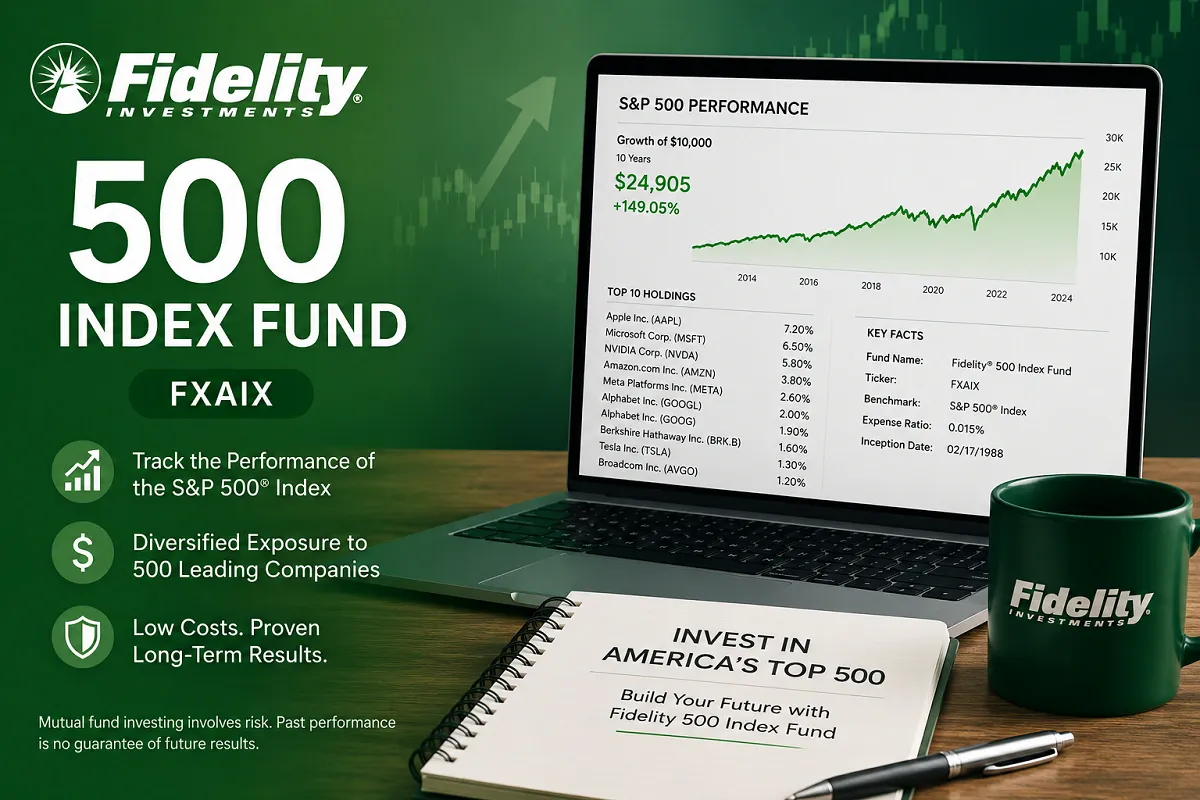
If you have ever opened a Fidelity investment account or navigated through a jobsite 401(k) menu, you have almost definitely seen the Fidelity 500 Index Fund. It is one of the largest investment funds on earth, with nearly $827 billion in investment holdings as of June 30, 2026, and it strives to do precisely one thing: It follows the S&P 500 closely while keeping costs very low. That clarity is accurately why it warrants a careful read rather than a spontaneous click. This guide walks through what the fund checks out, what it sets you back, how it has executed in boom times and harsh ones, how its managed fund structure discreetly modifies your tax consequence, and the particular circumstances where an S&P 500 ETF would serve you better.
What Is the Fidelity 500 Index Fund?
The Fidelity 500 Index Fund exchanges under the ticker FXAIX and is an unmanaged index mutual fund inside the Fidelity Concord Street Trust (CST). Its approach is simple: it usually invests at least 80% of its money in the stocks included in the S&P 500, using the same weighting as the index. Operational wealth management is handled by Geode Capital Management as sub-adviser, a detail many investors miss because the Fidelity brand sits on the label.
One clarification worth making up front: FXAIX is a mutual fund, not an exchange-traded fund. Fidelity does not currently available its own S&P 500 ETF, so searches for a “Fidelity S&P 500 ETF” almost always land here. The difference is not fastidious; it drives how you trade the fund and how it is taxed.
Fund Facts at a Glance
| Detail | Figure |
|---|---|
| Ticker / CUSIP | FXAIX / 315911750 |
| Structure | Index mutual fund (not an ETF) |
| Benchmark | S&P 500 Index |
| Morningstar category | Large Blend |
| Net expense ratio | 0.015% (often displayed rounded to 0.02%) |
| Portfolio assets | ≈ $827.5 billion (6/30/2026) |
| Turnover rate | 3% (as of 2/2026) |
| 3-year tracking error | 0.01 |
| Minimum initial investment | $0 |
| Share class inception | May 4, 2011 (underlying portfolio dates to 1988) |
| Sub-adviser | Geode Capital Management, LLC |
From Spartan to FXAIX: A Naming History That Still Confuses People
If you have run into conflicting tickers or expense ratios while researching this fund, there is a reason. The fund has been renamed once and restructured once in the last decade.
The 2016 Rebrand
Effective June 14, 2016, Fidelity dropped the “Spartan” label from its index fund lineup. Spartan 500 Index Fund became Fidelity 500 Index Fund. Stock symbols and CUSIPs did not change, and the “Fidelity Advantage Institutional” share class was retitled “Institutional Premium.” Archived pieces and board messages still use the Laconian moniker; that’s why the word appears in search results years later.
The 2018–2019 Share Class Consolidation
Fidelity then collapsed multiple share classes of 21 index funds into a single class. For this endowment, the institutional share class (FUSEX, 0.090%), First Class (FUSVX, 0.035%), and Institutional share Class (FXSIX, 0.030%) were consolidated into FXAIX at 0.015%. If an old statement or an outdated article shows you FUSEX, that position now lives in FXAIX at a materially lower fee.
One important point: “Since inception” performance starts from May 2011, when this share class was launched, even though the underlying portfolio has existed since February 1988. Long-term return charts can therefore look shorter than the fund’s real history.
What the Fund Actually Owns

A Cap-Weighted Slice of Large-Cap America
The portfolio holds the S&P 500 constituents in proportion to their market capitalisation, with roughly 99.6% in domestic equity and only a fraction of a percent in foreign-listed issues. Turnover sits near 3% per year, because the fund only trades when the index reconstitutes or when cash flows require rebalancing. That low trading activity helps keep the fund cheap and has historically resulted in fewer capital gains distributions.
Tracking has been tight. Over three years, tracking error has run around 0.01, meaning the fund does what it says on the tin. For an index fund, that is the single most important quality metric, ahead of any trailing return figure.
The Concentration Most Investors Underestimate
Holding 500 equities sounds highly diversified, and in one sense it is. But cap-weighting means the biggest handful of mega-cap tech giants’ names carry a disproportionate share of the asset pool, and that weighting has increased in weight over the last ten years. When you buy this fund, you are buying the index’s concentration along with its breadth. Check the current top-ten weight on Fidelity’s holdings page before assuming “500 stocks” means evenly spread risk.
Cost: What 0.015% Actually Buys You

The prospectus net expense ratio is 0.015%, which many data sites round to 0.02%, on a $10,000 position that is roughly $1.50 a year. There is no sales load, no 12b-1 fee, and no minimum initial investment.
Fee Drag in Real Money
The Large Blend category average expense ratio runs near 0.72%. On a $100,000 balance, that is about $15 a year here versus roughly $720 in an average category peer — before compounding. Over a 30-year accumulation period, that spread is not a rounding error; it is a meaningful share of the ending balance. Cost is the one variable in investing you control with certainty, and this fund sits at the low end of what exists.
Performance: What the Record Shows

Calendar-Year Total Returns
| Year | Total return | Year | Total return |
|---|---|---|---|
| 2025 | 17.86% | 2020 | 18.39% |
| 2024 | 25.00% | 2019 | 31.47% |
| 2023 | 26.28% | 2018 | −4.40% |
| 2022 | −18.12% | 2017 | 21.80% |
| 2021 | 28.69% | 2016 | 11.97% |
Trailing figures as of mid-2026 showed roughly 15.5% annualised over ten years and about 13.4% over five, against benchmark figures of approximately 15.51% and 13.41%. The discrepancy between fund and index approximates the management fee, which is precisely what an efficiently managed index fund should provide. Note the shape of that record, though: 2022 executed an 18% loss, and March 2020 generated an exponential monthly peak-to-trough decline. The averages are built out of years that did not feel average.
Dividends and Capital Gains
Distributions are paid quarterly. The trailing yield has recently sat in the 1.03%–1.06% range, roughly $2.72 per share annualized, around $105 a year on a $10,000 position. That is modest by design: the S&P 500 is a growth-and-income index whose largest constituents reinvest earnings rather than pay them out.
The fund has also been quiet on capital gains, distributing none in recent years, though it did make small distributions in the 2016–2019 stretch. Low turnover helps, but a mutual fund cannot use the in-kind redemption mechanism that makes ETFs structurally more tax-efficient, so future capital gains distributions are possible.
Fidelity 500 Index vs. S&P 500 ETFs

Where the Mutual Fund Structure Wins
- $0 minimum and true dollar-based investing — you can put $37 to work without worrying about share prices.
- Clean automatic contributions and dividend reinvestment, which suits payroll-driven retirement investing.
- No bid-ask spread and no temptation to trade intraday.
- The lowest headline fee in the S&P 500 category at 0.015%.
Where an ETF Is the Better Tool
- Brokerage accounts: ETFs such as VOO or IVV (both around 0.03%) utilize in-kind distributions and infrequently allocate investment profits.
- Transferability: FXAIX is a Fidelity house fund. Moving to another brokerage generally requires selling, which can trigger a taxable event outside a retirement account.
- Active intraday oversight: limit orders and immediate trade processing are completely inaccessible in a fund priced once daily at NAV.
The working principle most long-term investors land on: FXAIX inside a 401(k) or IRA, an S&P 500 ETF inside a non-retirement investment account. The underlying exposure is effectively identical either way.
Risks You Should Price In
- Market risk. The fund is 100% equity with no conservative asset mix. A 20%+ downturn is a standard function of the index, not an irregularity.
- Concentration risk. Cap weighting ties a large share of your outcome to a small number of mega-cap companies.
- Incomplete market coverage. The S&P 500 screens out mid-caps, small-caps and all foreign stocks. Investors wanting wider market access often pair or substitute it with a total-market or international index fund.
- Structural friction. End-of-day pricing, proprietary status and mutual fund tax mechanics all matter more in taxable accounts than in retirement accounts.
How to Buy the Fidelity 500 Index Fund
Decide the account before you determine the fund. In a 401(k) or 403(b), the fund may emerge under an abbreviated menu layer name such as “FID 500 INDEX” rather than its full title; same fund, truncated view. In an IRA or taxable Fidelity account, you can purchase directly by ticker with no minimum allocation, set up automated deposits, and switch dividend accumulation on. Then read the statutory summary, which is short, free, and the definitive source for fees and vulnerabilities.
Conclusion
The Fidelity 500 Index Fund is not an ingenious solution, and that is the point. It monitors a common knowledge index with tight benchmark replication, charges 0.015%, mandates no minimum allocation, and has exacerbated in line with the U.S. large-cap market for ten-year stretches. For a foundational American stock holding inside a retirement account, it is authentically hard to beat on cost or implementation.
What it does not do is broaden exceeding 500 large U.S. companies, shield you from a 20% withdrawal, or fluctuate as tax-optimally as an ETF in a standard brokerage account. Match the vehicle to the account, understand that the index’s concentration is now part of the deal, and verify current figures against Fidelity’s own fund page before you commit capital. Done on those terms, this fund is one of the more justifiable baseline choices available to a conventional investor.
Frequently Asked Questions:
Q: Is the Fidelity 500 Index Fund the identical outcome as FXAIX?
Yes. FXAIX is the stock symbol for the Fidelity 500 Index Fund. Older stocks such as FUSEX, FUSVX, and FXSIX were aggregated into FXAIX and have ceased as separate stock classes.
Q: Is FXAIX an ETF?
No. It is an index open-end fund that prices once per day at net worth value after the market closes. At present, Fidelity does not offer its own S&P 500 ETF.
Q: What is the management fee of the Fidelity 500 Index Fund?
The offering memorandum annual management fee is 0.015%, regularly displayed as 0.02% by data vendors that round to two decimals.
Q: Does the Fidelity 500 Index Fund pay yield earnings?
Yes, quarterly. The recent trailing yield has run roughly 1.03%–1.06%, or about $2.72 per share annualised. Allocations can oscillate interannually.
Q: Is FXAIX superior to VOO?
They track the same index and perform almost identically. FXAIX has a slightly lower fee and a $0 minimum; VOO is more tax-efficient in taxable accounts and portable between brokerages. Account type usually decides it.
Q: What is the minimum investment?
$0. Fidelity removed minimums on its index mutual funds, and fractional dollar amounts are accepted.
Q: Is it a good fund for beginners?
It is a standard foundational asset for new investors because it is inexpensive, broad-based, spanning 500 large companies, and easily automated. It is still a 100% equity fund, so it carries full stock market risk and suits money you will not need for years.
For any suggestions or changes, please contact us.