If you have a Fidelity investment account and you’re building a long-term investment portfolio, two funds keep turning up in every suggestion list: FXAIX and FSKAX. They look nearly indistinguishable on the surface — same fund family, near-zero fees, vast asset portfolios, and top holdings you already realize(Apple, Microsoft, Nvidia). Still, they aren’t the identical product, and the decision between them shapes what statement of the U.S. stock market you manage productively.
This article demonstrates a process for understanding the main dissimilarities in the FXAIX vs FSKAX debate: what each fund tracks, how they evaluate on cost and productivity, how their tax treatment compares, and which type of investor each one suits perfectly.
FXAIX vs FSKAX at first Sight
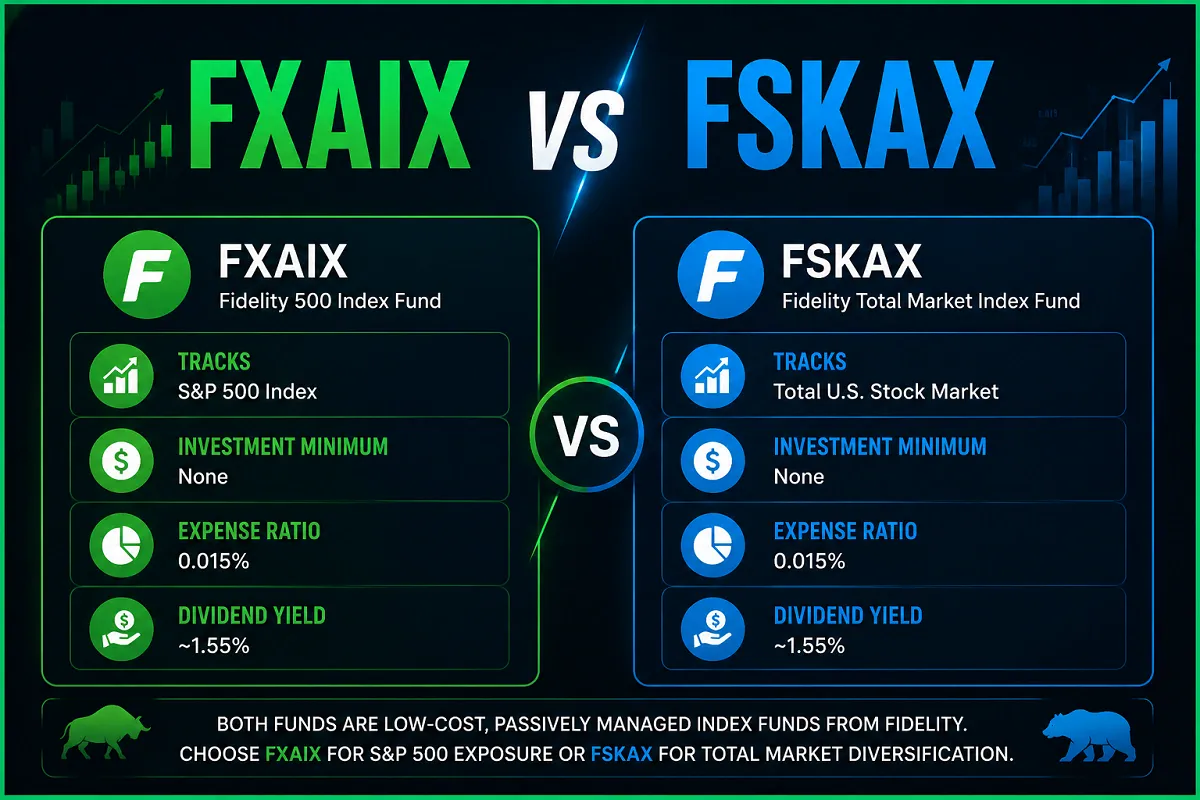
- FXAIX: Fidelity 500 Index Fund. Follows the S&P 500 (~500 large-cap U.S. stocks).
- FSKAX: Fidelity Total Market Index Fund. Follows the Dow Jones U.S. Total Stock Market Index (~3,700+ U.S. stocks across large-, mid-, and small-cap).
- Expense ratio: both invoice 0.015%.
- Starting Capital: $0 for both.
- Transaction fee at Fidelity: none.
- Overlap: roughly 89% by weight.
They share DNA. The gap between them is not their fees or their broker; it’s what sits below the top 500 companies.
About FXAIX
FXAIX, the Fidelity 500 Index Fund, is an unmanaged mutual fund that reflexes the S&P 500. The S&P 500 is not merely “the 500 largest U.S. companies.” A council at S&P Global selects residents centered on market cap, liquid assets, U.S. domicile, and stable business operation; that’s why the count rests just above 500 in practice.
FXAIX has existed fundamentally since 1988, with its existing share class rolled out in 2011. It carries a 0.015% expense ratio, no minimum investment, and distributes comprehensive market coverage to America’s biggest publicly traded businesses. Because the S&P 500 covers approximately 80% of the total U.S. equity market by capital structure, a single share of the FXAIX productively gives you a portion of the country’s economic heavyweight class.
Aggregate Holdings of FXAIX
The fund is market-cap calibrated, so the biggest names controlling a situation. Apple, Microsoft, Nvidia, Amazon, and Alphabet commonly occupy the apex, with the top 10 positions finance for approximately 25% of total assets in current reporting periods.
About FSKAX
FSKAX, the Fidelity Total Market Index Fund, follows the Dow Jones U.S. Total Stock Market Index. That baseline metrics serve as an agent for the entire allocation field of the U.S. stock market, with north of 3,700 components extending across large-, mid-, and small-cap companies.
Like FXAIX, it charges 0.015%, has no lowest, and no-transaction-fees (NTF) trades on Fidelity’s platform. What you’re paying for is broader coverage: on top of the same 500 names inside FXAIX, FSKAX layers on thousands of smaller companies that never appear in the S&P.
Aggregate Holdings of FSKAX
The top 10 in FSKAX read almost identically to FXAIX because both funds are market-cap weighted and the same mega-caps sit at the top of the U.S. market. The difference is that in FSKAX, those top 10 make up a smaller share of the portfolio, around 21%, because the fund’s weight is spread across thousands more companies.
FXAIX vs FSKAX: Feature-by-Feature Analysis
Operating Expenses and Fees
Both funds charge 0.015% annual operating expenses. On a $10,000 investment, that’s $1.50 per year, productively a quantization error. Fidelity does not charge service charges to buy or sell any fund on its own platform, and neither fund has a load or 12b-1 fee. On cost, this comparison is a tie.
Holdings and Diversification
This is the real story. FXAIX holds roughly 500 large-cap stocks. FSKAX accommodates those same 500 plus nearly 3,300 extra mid- and small-cap names. That added scope doesn’t make as big an impact as it seems, because capitalization-weighting means the top 500 companies already registry for around 89% of FSKAX’s total portfolio worth. The remaining thousands of holdings sit inside that final ~11%.
Still, that 11% is what differentiates the funds. Historically, small- and mid-cap stocks have carried different risk and return characteristics than large-caps, and financial research has long treated the small-cap tilt as a distinct source of expected return.
Prior Metrics
Because the two funds coincide substantially, they have paralleled each other closely. Research vendor Portfolios Lab reports an association of 0.99 between them across time horizons, mathematically about as close as two different funds get.
During the past ten years, FXAIX has marginally outperformed FSKAX. That difference highlights one leading trend rather than an enduring competitive advantage: large-cap technology stocks have led the U.S. market. In years when small- and mid-caps market recovery, FSKAX closes or flips that disparity. Historical returns are not indicative of future performance, and the historic spread between the two has seldom surpassed 1 to 2 percentage points in a single year.
Stock Investment Yield
FXAIX typically posts a slightly higher trailing 12-month yield than FSKAX. The reason is compositional, large, mature companies inside the S&P 500 tend to pay more of their earnings as dividends, whereas the smaller-cap names layered into FSKAX skew toward reinvestment. The difference is small and can shift over time.
Tax Efficiency
Both funds run low turnover rates, around 2% annually, which keeps taxable capital gains distributions modest. That makes each fund reasonably tax-efficient for a taxable brokerage account, though as index mutual funds they can still distribute capital gains, unlike many ETFs. If tax minimization in a taxable account is your top priority, ETF alternatives like VOO or VTI deserve a look alongside these two.
Which Fund Should You Choose?
Choose FXAIX If
- You want pure large-cap U.S. exposure and are comfortable being concentrated in the biggest, most established companies.
- You’re pairing this fund with separate small- or mid-cap funds elsewhere in your portfolio.
- You like tracking the most widely quoted U.S. equity benchmark.
Choose FSKAX If
- You prefer a single-fund solution that covers the entire U.S. stock market.
- You want to keep some exposure to small- and mid-caps without buying additional funds.
- You’re aiming for the simplest possible core holding in a long-term retirement account.
Can You Own Both FXAIX and FSKAX?
Technically yes, practically no. Because roughly 89% of FSKAX’s weight is already in the S&P 500 names FXAIX holds, owning both mostly overweight’s your large-cap allocation without adding meaningful diversification. For most portfolios, one or the other as your U.S. equity core is the cleaner choice.
Final Words
FXAIX vs FSKAX is one of the most mutual agreement Fidelity investors visages, and it’s a case where the “wrong” answer isn’t completely incorrect. Both funds are affordable, tax-efficient, and built to follow the U.S. market for the long term. FXAIX is an intensive bet on America’s biggest companies. FSKAX is a wider bet on the U.S. commercial landscape as a whole. Pick the vulnerability you want, hold it invariably, and let time do the hard work.
Disclaimer:
This article is for learning only. It is not personal investment advice. Information about the fund, its fees, and its investments can change over time. Before you invest, check the latest information on Fidelity’s website. If you need advice for your own situation, talk to a licensed financial advisor.
FAQs:
Q: Is FXAIX or FSKAX preferable for a Roth IRA?
Both fit a Roth IRA well. FXAIX gives you condensed large-cap vulnerability; FSKAX gives you the whole U.S. market in one fund. Extended timeframes favor whichever you’ll stay invested in through downturns.
Q: Do FXAIX and FSKAX pay dividends?
Yes, both pay dividends on a three-month timetable. FXAIX typically has a marginally increased output because large-cap companies distribute more of their profits than smaller companies, multilevel into FSKAX.
Q: What is the expense ratio for FXAIX vs FSKAX?
Both charge 0.015%, which works out to $1.50 per year on every $10,000 invested. Some literary repositories round this to 0.02%.
Q: Is FSKAX more multiform than FXAIX?
Yes, in terms of constituent volume. FSKAX holds around 3,700+ stocks versus nearly 500 in FXAIX. In practice, both are controlled by the same mega-cap names, so the incremental risk reduction is marginal.
Q: Can I switch between FXAIX and FSKAX without a fee at Fidelity?
There are no transaction fees on Fidelity’s platform for either fund. Nevertheless, if you sell in a taxable account, tax liabilities on profits may persist.