If you have worn out any time reading about investing, you have probably seen someone suggest an s and p 500 index fund as the “baseline portfolio” every new investor should ponder. Warren Buffett has been saying this for many years, and Vanguard founder Jack Bogle built his entire investment approach around this idea. But what is the s and p 500 index fund, precisely, and why does it hold the largest allocation in long-term portfolios? This guide analyzes what the fund is, how it works, which funds faithfully trace the S&P 500 today, what they cost in 2026, and the basics newcomers must understand before allocating any funds.
What Is the s and p 500?
Before you can understand an s and p 500 index fund, you need to understand the reference index. The s and p 500, short for the Standard & Poor’s 500, is a stock market index preserved by S&P Dow Jones Indices. It tracks nearly 500 of the largest publicly held corporations in the United States, covering 11 major sectors that incorporate information technology (IT), healthcare, financials, non-essential goods, and energy.
How the Index Is Constructed
The s and p 500 is value-weighted, meaning larger companies have a bigger impact on the index’s daily movement than smaller ones. A committee at s and p Dow Jones Indices selects the components based on requirements such as market cap, liquidity, US domicile, and reliable earnings. This committee-based oversight sets the S&P 500 apart from purely algorithmic benchmarks like the Russell 1000.
What Is an s and p 500 Index Fund?
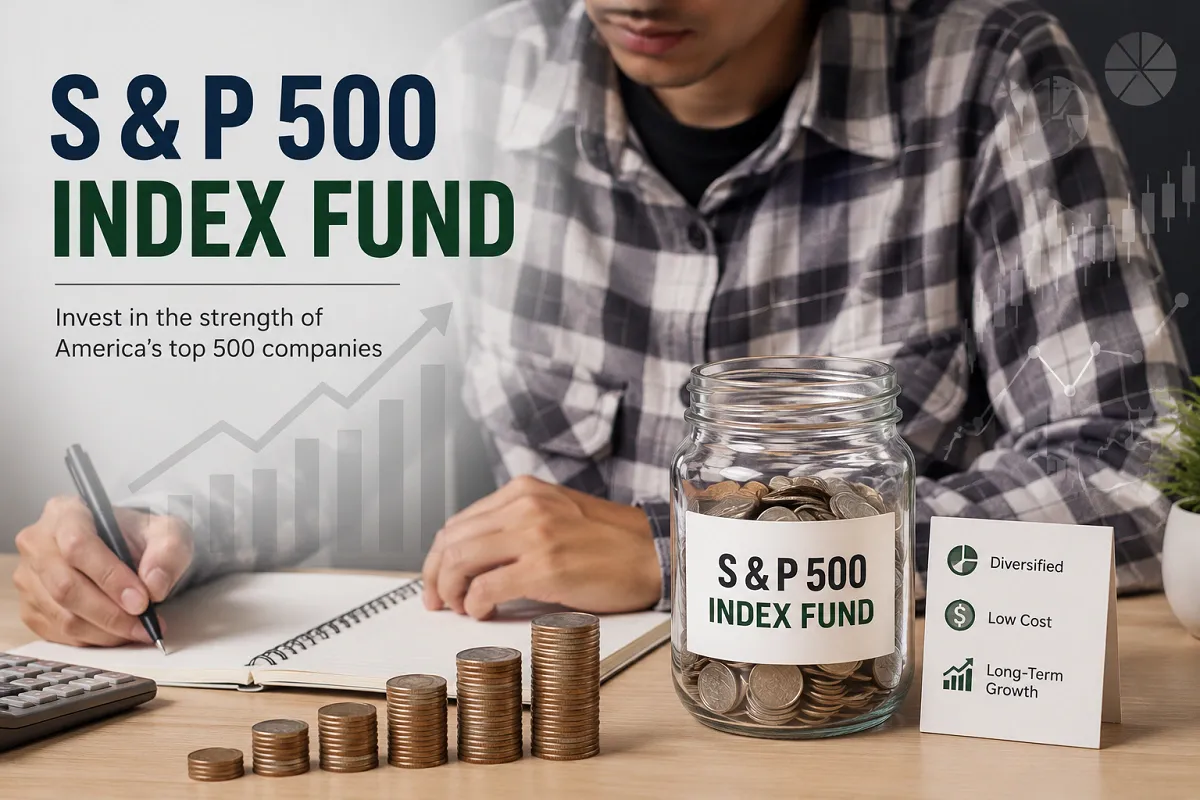
An s and p 500 index fund is a collective investment vehicle (CIV), usually an open-end fund or an exchange-traded fund (ETF), that aims to recreate the track record of the S&P 500 index. Rather than trying to beat the market by active management, the fund simply holds the same 500 companies in approximately the same percentage as the index itself.
The result is a hands-off, low-cost, broadly diversified investment that fluctuates with the more comprehensive US large-cap market. If the S&P 500 is up 12% this year, a well-managed index fund should also make about 12%, minus a very small fee.
ETF vs. Index Fund: A Beginner’s Comparison
An s and p 500 index fund comes in two wrappers, and it helps beginners to understand the distinction:
- Mutual funds like FXAIX or VFIAX trade once per day at the closing net asset value (NAV). They are well-suited to automated recurring investments in dollar amounts.
- ETFs like VOO or IVV trade throughout the day like stocks. They are often more tax-efficient in taxable accounts and easier to move between brokerages.
Both track the same index. The choice usually comes down to which brokerage you use and how you prefer to invest.
How s and p 500 Index Funds Work
Because index funds are passively managed, there is no team of analysts hand-picking stocks. The manager’s job is simply to mirror the index as closely as possible. That model has two major consequences for investors:
- Very low expense ratios. With no expensive research team to fund, providers can charge a fraction of what an actively managed fund charges.
- High tax efficiency. Passive funds trade very little inside the portfolio, which limits taxable capital gains distributions.
The trade-off is that you accept the market’s return, no more and no less. For most long-term investors, that is a feature rather than a bug.
The Best S&P 500 Funds to Invest in During 2026
Different funds trace the s and p 500, and the dissimilarities between them are unexpectedly compact. What signifies most is accessibility at your brokerage and the annual operating expenses.
FXAIX, Fidelity’s S&P 500 Index Fund
FXAIX is Fidelity’s crown jewel s and p 500 index fund. It conveys an expense ratio of just 0.015% and is accessible from the first dollar, making it one of the expensive and most approachable S&P 500 funds on the market.
VFIAX and VOO, Vanguard’s Two Options
Vanguard offers both an actual fund (VFIAX at 0.04%, with a $3,000 minimum) and an ETF (VOO at 0.03%, no account baseline above market price). VFIAX is the next-generation replacement to the original 1976 index fund Jack Bogle started as the First Index Investment Trust, the fund that birthed the index fund revolution.
SWPPX, Schwab s and p 500 Index Fund
Charles Schwab’s s and p 500 index fund charges 0.02% and has no minimum investment. It is the natural pick for investors who already hold accounts at Schwab.
IVV and SPY, iShares and SPDR ETFs
IVV from iShares (0.03%) and SPY from State Street are two more well-known S&P 500 ETFs. SPY is the oldest ETF in the world, launched in 1993, but it carries a higher expense ratio than IVV and VOO.
Why Investors Choose s and p 500 Index Funds
Historical Returns
Because the s and p 500 was established in 1957, it has yielded a smoothed annual yield of approximately 10% before CPI adjustments, according to S&P Dow Jones Indices data. That statistic includes collapses, downturns, and sustained upward cycles. Track record never assurances future results, but few approaches have matched that extended-horizon reliability.
Low Costs
At 0.015% to 0.04%, top s and p 500 index funds are included in the affordable investment offerings ever developed. On a $10,000 balance, that works out to between $1.50 and $4.00 a year in fees. Across decades of cumulative growth, low costs are one of the most dependable indicators of net investor returns.
Diversification and Simplicity
A single unit of stock of an S&P 500 fund gives you micro investing in 500 leading American companies spanning 11 market sectors. That is instantaneous risk dispersal, no active equity selection, and no continuous realignments obligatory from you.
Risks and Limitations to Understand
An S&P 500 index fund is not a risk-free investment. The key considerations include:
- Market risk. The index has lost more than 30% in a single year during major downturns such as 2008.
- US-only exposure. It holds no international stocks, so it is not a truly global portfolio on its own.
- Top-heavy concentration. The largest 10 companies now make up a significant share of the index, which increases exposure to a small group of megacap technology names.
- No downside protection. During a bear market, the fund falls with the market. There is no active manager attempting to move to cash.
How to Start Investing in an s and p 500 Index Fund
- Open an account. Options include a taxable brokerage account, a Roth or Traditional IRA, or a workplace 401(k).
- Choose the fund. Pick the s and p 500 fund your brokerage offers without a transaction fee, typically FXAIX at Fidelity, VOO or VFIAX at Vanguard, and SWPPX at Schwab.
- Decide on a contribution schedule. Most beginners benefit from automatic monthly investments, a strategy known as dollar-cost averaging.
- Hold long term. Index investing rewards patience, not tactical trading. Reinvest dividends and let compounding do the work.
Final Thoughts
So, what is the s and p 500 index fund in one sentence? It is a low-cost, index-tracked fund that gives you a share in nearly 500 of the largest US companies with a one-off purchase. It will not beat the market in any given year, it is the market. That is specifically why it has turned into the foundational component for millions of buy-and-hold investors, from newcomers opening their first Roth IRA to legends like Warren Buffett. Choose a low-cost fund, chip in consistently, and let compounding take effect.
People Also Ask
Q: Is an s and p 500 index fund a good investment for beginners?
For most newbies with an extended horizon, a low-cost s and p 500 index fund is one of the highly recommended baselines in money management. It is varied across 500 large US companies, has exceptionally low fees, and demands no continuous oversight. That said, it is a stock investment, so it can depreciate in a bear market and works best when paired with a long-term plan.
Q: How much money do I need to start?
Some funds demand a minimum, VFIAX at $3,000, for example, but many of the widely preferred s and p 500 index funds, incorporating FXAIX, SWPPX, and ETFs like VOO, have no minimum order quantity of a single share or a dollar-based partial ownership.
Q: What is the difference between FXAIX and VOO?
Both track the s and p 500. FXAIX is a Fidelity actual fund (0.015% expense ratio, priced once per day), while VOO is a Vanguard ETF (0.03%, trades throughout the day). Sustained returns are roughly similar; the selection typically hinges on which brokerage you use.
Q: Do s and p 500 index funds pay dividends?
Yes. The portfolio holdings distribute yield, and passive vehicles distribute income to investors, usually four times a year. Most brokerages let you roll over dividends mechanically, so they grow exponentially in tandem with your recurring deposits.
Q: Can I lose money in an s and p 500 index fund?
Yes. Because the fund traces the stock market, it slumps when the market falls. Prior portfolio retrenchments have surpassed 30% in protracted market crashes like 2008. However, across multi-generational horizons, the index has bounced back from all historical contractions. Time in the market has historically outstripped attempts to time the market.