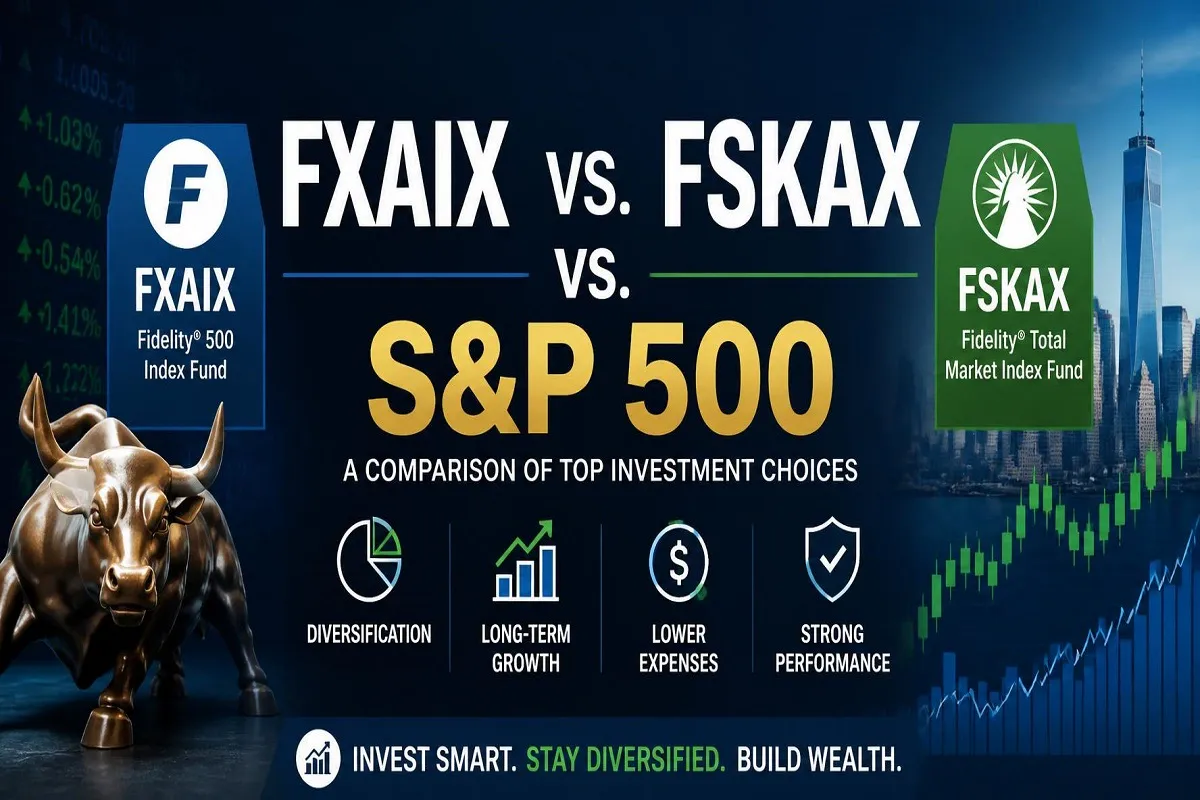
If you have a Fidelity investment account or 401(k), you’ve likely run into the same question: FXAIX or FSKAX? And where does “the S&P 500” technically fit into that choice, since it isn’t something you can invest in directly? This guide analyzes what each fund actually holds, how their expenses and returns compare, and which one (or both) makes sense based on what you’re building. By the end, you’ll understand FXAIX vs. FSKAX vs. S&P 500, how FXAIX, FSKAX, and the S&P 500 Index relate to one another, and which option best aligns with your investment objectives.
Understanding FXAIX, FSKAX, and the S&P 500
Prior to benchmarking, it ensures clarity on what each of these three expressions signify to, because only two of them are funds you can own.
FXAIX: Fidelity 500 Index Fund
FXAIX is the Fidelity 500 Index Fund, an actual fund started in 2011 that follows the S&P 500 index. It holds nearly 500 of the largest exchange traded U.S. companies, market-cap weighted, which means corporate titans like the Magnificent Seven (Mag 7) leaders make up an outsized concentration. FXAIX is one of the biggest index actual funds in the country, with hundreds of billions of dollars in holdings, and it charges a razor-thin management fee with no minimum investment compulsory.
FSKAX: Fidelity Total Market Index Fund
FSKAX is the Fidelity Total Market Index Fund. Instead of tracing the S&P 500, it monitors the Dow Jones U.S. Total Market Benchmark, giving it vulnerability to multiple thousand U.S. companies of all sizes, large-cap, mid-cap, and small-cap. In execution, FSKAX still depends crucially on the same large-cap names that overshadow the S&P 500, since those companies constitute the majority of total U.S. market value, but it integrates a vast long tail of micro-enterprises that FXAIX doesn’t touch.
The S&P 500 Index Itself
The S&P 500 is not a consumer good; it’s a reference index supported by S&P Dow Jones Indices that replicates the 500 large U.S. companies designated by an index methodology committee, liquidity, and financial viability standards. When people say they want to “invest in the S&P 500,” what they genuinely mean is buying a fund that monitors it, such as FXAIX, or a same fund from an alternative vendor like Vanguard’s VFIAX or an ETF such as VOO or IVV. So, the authentic benchmark isn’t “FXAIX vs. the S&P 500”; it’s “how closely does FXAIX track the S&P 500,” and the answer is: in lockstep, since that’s its full scope of work.
FXAIX vs FSKAX vs S&P 500: Key Differences at a Glance
| Feature | FXAIX | FSKAX | S&P 500 (index) |
| What it is | Mutual fund | Mutual fund | Benchmark index |
| Tracks | S&P 500 | Dow Jones U.S. Total Stock Market Index | Itself |
| Approx. holdings | ~500 large-cap stocks | ~3,700+ stocks (all cap sizes) | 500 large-cap stocks |
| Expense ratio | ~0.02% | ~0.02% | Not applicable |
| Minimum investment | $0 | $0 | Not applicable |
| Dividend yield | ~1.0% | ~0.9%–1.0% | Varies |
| Best for | Pure large-cap exposure | Total-market diversification | Benchmark comparison only |
Both Fidelity funds charge among the lowest expense ratios in the entire mutual fund industry, and both require no minimum to open a position, which is part of why they’ve become default choices for long-term retirement investors.
Performance Comparison: FXAIX vs FSKAX vs S&P 500
Latest Performance
Because both funds are controlled by the same large-cap companies, their profits oscillate highly correlated. Current statistics shows FXAIX and FSKAX recording virtually indistinguishable one-year yields, with the growing disparity marginally exceedingly longer three-, five-, and ten-year periods, where FXAIX has typically published a slight advantage. Since FXAIX exists particularly to mirror the S&P 500, its execution and the index’s performance are, by design, fundamentally the same before fees.
Why FXAIX Comes Out on Top?
FXAIX’s upper hand over FSKAX in recent times ultimately boils down to one factor: the exceptional results of a handful of large-cap technology and communication-services companies. Because FXAIX focuses its vulnerability in the 500 largest companies, it records a marginally larger share of those winners than FSKAX, which waters them down with thousands of fractional stakes.
How Might FSKAX Bridge the Gap?
That same vibrant creations, in turn, back when minority equities pace the market. In intervals where small- and mid-cap equities beat the market mega-cap names, FSKAX’s wider asset dispersion tends to help it close the gap with FXAIX, or even forge ahead. In the past, power changes hands between large caps and smaller companies over long term trends, which is the main point for owning the total market rather than focusing solely on the largest names.
Expenses and Charges
Cost is fundamentally a moot point between these two funds. Both FXAIX and FSKAX carry management fees around 0.02%, meaning an investor pays nearly $2 a year for every $10,000 invested, with no sales charges, no transaction fees at Fidelity, and no entry requirement. At that level, the difference in fees between the two funds has virtually unnoticeable impact on long-term profits; what matters far more is which index each fund monitors and how that aligns with your strategy.
Portfolio Risk Overview
On paper, FSKAX appears more varied because it holds thousands more companies. In practice, the risk-reduction value is smaller than it appears, because both funds are capitalization-proportional, meaning the largest companies control both investment holdings irrespective of how many total assets each one has. The relationship between FXAIX and FSKAX has traditionally run close to 0.99, so holding both at the same time adds diminishing diversification returns; you’re essentially duplicating up on the identical foundation vulnerability rather than substantially dispersing risk. Effective asset dispersion away from U.S. large-cap risk would come from adding foreign equities, bonds, or other investment categories, not from reallocating assets between FXAIX and FSKAX.
Which Fund Fits Your Investment Goals?
Choose FXAIX If…
You want the simplest, most direct way to own the S&P 500 inside a Fidelity account, you’re comfortable with large-cap concentration, and you like the fact that FXAIX’s performance will track the index almost exactly, minus its tiny fee.
Choose FSKAX If…
You want broader exposure to the entire U.S. stock market, including small- and mid-cap companies that aren’t part of the S&P 500, and you’re comfortable trading a small amount of large-cap concentration for wider diversification across company sizes.
Should You Own Both?
Because the two funds intertwine, most investors don’t need to accommodate. Selecting one and sustaining is generally more cost-effective than allocating funds between funds that are functionally interchangeable. The irregularity is an investor who intentionally wants to overweight large caps within an otherwise total-market equivalent, though even that goal can usually be accomplished more directly by recalibrating funding amounts rather than carrying overlapping positions.
How to Buy FXAIX or FSKAX
Both funds are accessible zero-commission to Fidelity online broker, IRA, and workplace retirement plan account holders, and can ordinarily be purchased in proportional dollar amounts rather than integer shares. Outside of a Fidelity account, investors targeting comparable risk profiles would generally look at analogous low-cost index funds or ETFs from other vendors, since Fidelity mutual funds are primarily built for Fidelity’s own platform.
Final Words
FXAIX and FSKAX solve intertwined but discrete issues. FXAIX gives you a clean, low-cost way to own the S&P 500’s 500 biggest U.S. companies, while FSKAX prolongs that same low-cost method across the whole U.S. stock market, featuring thousands of smaller businesses the S&P 500 leaves out. The S&P 500 itself is simply the touchstone that FXAIX is built to mirror, not an independent investment vehicle. With fees this close to zero for both funds, the verdict really comes down to whether you want pure large-cap vulnerability or total-market range, not which fund is “affordable” or “better” in concrete figures. Whichever you choose, both are widely considered as solid, low-fee foundational assets for tax-advantaged retirement vehicles, though as with any investment decision, it’s worth verifying current fund data on Fidelity’s website and contemplating how the choice fits your comprehensive portfolio, holding period, and risk appetite, ideally with input from a certified financial planner (CFP).
People Also Ask
Q: Is FXAIX better than FSKAX?
A: Neither fund is objectively “better”; they track different indexes. FXAIX has posted slightly higher returns over recent multi-year periods due to large-cap outperformance, but FSKAX’s broader exposure could outperform in periods when small- and mid-cap stocks lead the market.
Q: What is the difference between FXAIX and the S&P 500?
A: There isn’t a meaningful investment difference; FXAIX is a mutual fund built specifically to track the S&P 500 index. The S&P 500 itself isn’t investable directly; FXAIX is one of the ways to gain that exposure.
Q: Does FSKAX include the S&P 500?
A: Yes. FSKAX’s total-market index includes essentially all of the same large-cap companies found in the S&P 500, plus thousands of additional mid-cap and small-cap stocks that the S&P 500 excludes.
Q: Can I own both FXAIX and FSKAX at the same time?
A: You can, but because the two funds overlap heavily and have a very high historical correlation, holding both typically adds limited diversification benefit compared to simply choosing one and investing consistently.