If you’ve ever opened a Fidelity account and tried to choose a US stock index fund, you’ve probably been confused between FSKAX and FXAIX. The two funds look almost identical: Both funds have very low fees, both follow the US stock market, and both are very popular Fidelity index funds. But the truth is that they track two different indexes, and there are slight but significant differences in their results. In this article, we’ll take a detailed look at FSKAX vs FXAIX: what the two funds are, their expense ratios (fees), holdings, historical performance, risk profile, and tax aspects. In the end, you’ll have a clearer idea of which fund is best for your investment strategy, or whether it’s worth owning both.
Important note: This article is for educational purposes only and is not financial guidance. Please consult a licensed financial advisor before making any investment determination.
What are FSKAX and FXAIX?
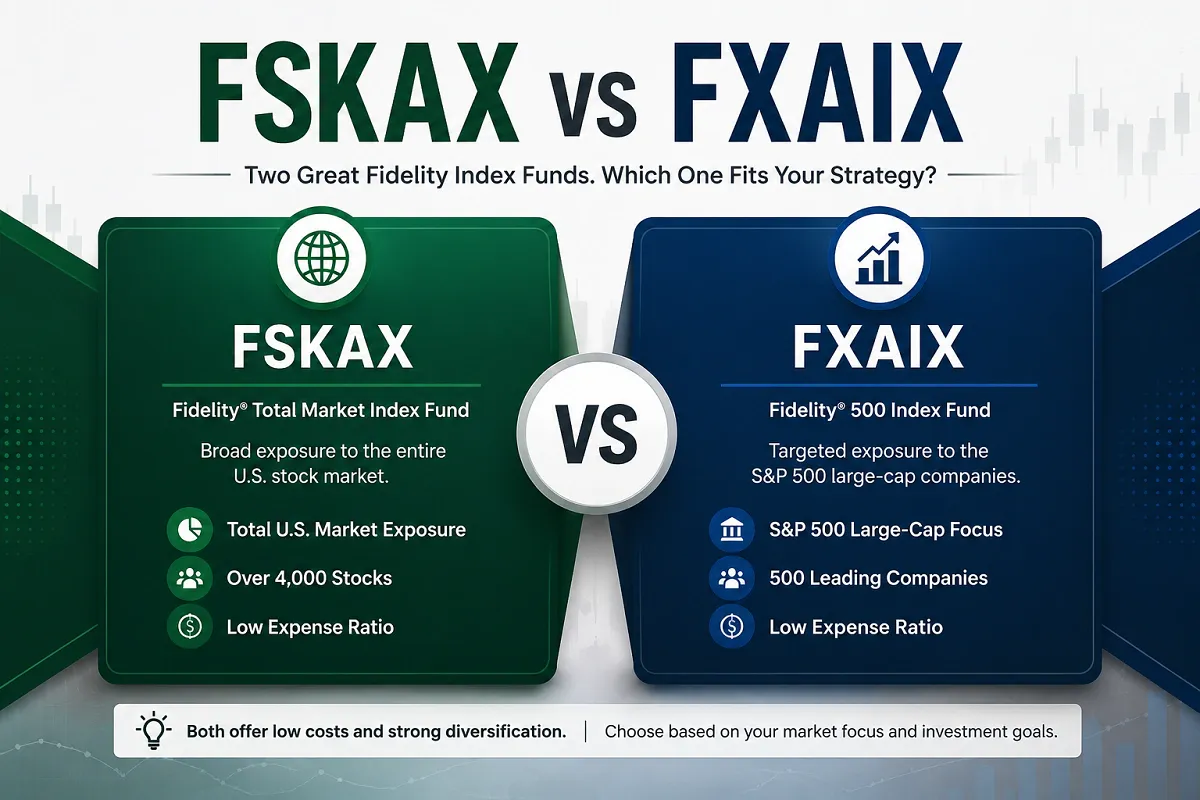
FSKAX: Fidelity Total Market Index Fund
FSKAX’s full name is Fidelity Total Market Index Fund. It’s a submissively managed shared fund that monitors the Dow Jones U.S. Total Stock Market Index. The index includes about 3,800 to 4,000 U.S. companies, large-cap, mid-cap, and small-cap.
Simply put: By buying FSKAX, you’re buying a small portion of the entire U.S. stock market.
FXAIX: Fidelity 500 Index Fund
FXAIX, or Fidelity 500 Index Fund, tracks the S&P 500, the most popular U.S. index. It incorporates about 500 to 507 large US companies, selected by a council based on liquidity and profitability. Giants like Apple, Microsoft, and Nvidia are its largest holdings.
Key differences at a glance
Aspect FSKAX FXAIX
Index Dow Jones U.S. Total Stock Mark S&P 500
Number of holdings About 3,800–4,000 About 500
Market cap coverage Large + Mid + Small Cap Large Cap only
Expense ratio 0.015% 0.015%
Minimum investment Zero Zero
Fund type Index mutual fund Index mutual fund
Expense ratio: Fee comparison
It’s easy to decide here because the expense ratio of both funds is exactly the same: 0.015%. That’s just $15 per year on an investment of $100,000.
These fees are exceptionally low by industry standards. The average expense ratio of typical mutual funds ranges from 0.3% to 0.9%, while these two Fidelity funds are twenty to sixty times cheaper. In addition, both have no transaction fees on the Fidelity platform and no minimum investment requirement.
Conclusion: Both are equal in terms of fees; this factor will not sway your decision.
Holdings and Overlap: 89% Identical
The most interesting fact about FSKAX and FXAIX is their overlap. Since both funds are market-cap weighted (meaning larger companies are more heavily weighted),
- The top 500 companies in FSKAX make up about 89% of the fund’s total value
- The left behind 3,300 or so mid-cap and small-cap enterprises make up just 11%
- The top 10 holdings in both funds are exactly the same (Nvidia, Apple, Microsoft, etc.)
This means that when you buy FSKAX, you get 89% of what you get in FXAIX, and only 11% additional exposure to small and mid-cap companies.
Should you hold both funds together?
The correlation between the two funds is about 0.99 to 1.00, meaning they move in the same direction. Holding both together doesn’t really add diversification; you’re essentially doubling your exposure to the same market segment. It’s better to choose one.
Comparing performance: Which has the better return?
FXAIX has marginally outperformed FSKAX in recent years, across all three time periods: short, medium, and long. The main reason for this is that since 2023, the bulk of the market’s growth has come from the “Magnificent Seven” of large technology companies (Nvidia, Apple, Microsoft, etc.).
When large-cap companies dominate the market:
- FXAIX benefits because its entire holdings are in the top 500
- FSKAX’s returns are slightly “diluted” because 11% of its holdings are in smaller companies that underperformed during the period
But remember: this trend is not permanent. There have been periods in history when small-cap and mid-cap companies outperformed large-cap companies. If such a period occurs in the future, FSKAX could outperform. Past performance is no guarantee of future results.
Risk and Volatility
- Volatility: FSKAX about 5.09% and FXAIX about 5.02% — roughly equal
- Maximum Drawdown: FSKAX’s maximum loss was -35.01%, while FXAIX was -33.79%. FSKAX falls slightly more because small-cap companies are more affected by downturns
- Dividend Yield: FXAIX is about 1.04%, while FSKAX is about 0.94%; FXAIX’s dividend is slightly better
Tax and Account Type Aspects
Both of these are mutual funds, not ETFs. Because of this, they can create taxable capital gains if you hold them in a regular (non-retirement) brokerage account, which may be less tax-efficient than an ETF. However:
- This difference may be irrelevant in retirement accounts (Roth IRA, Traditional IRA, 401(k))
goes because there is no annual tax
- Both funds are considered excellent core holdings for retirement investing due to their low fees and broad diversification
- If you’re investing in a taxable account, you might also want to look at ETF options like ITOT or VOO.
Which fund is best for whom?
Choose FSKAX if:
- You want revelation to the complete U.S. market, large, mid, and small companies all
- You believe that small-cap and mid-cap companies can outperform in the future
- You want a “set-and-forget” approach to total market investing
- You want one fund that spreads your money across many different investments.
Choose FXAIX if:
- You want exposure to only the largest and most stable U.S. companies
- You want to track a well-known and trusted benchmark like the S&P 500
- You like a slightly better dividend yield and a slightly lower drawdown
- You want to add small-cap exposure to your portfolio from a separate fund
Realistic Summary
The truth is, the differences between the two funds are so small that for most long-term investors, neither choice is wrong. The 89% overlap, similar fees, and near-perfect correlation mean that your success will depend more on how consistently you stay invested than on fund selection. The general advice from experts is: don’t overthink it, pick one, and stick with it for the long haul.
Final Words
The FSKAX vs FXAIX comparison is really a “whole market vs. top 500” comparison. FSKAX gives you full market exposure to about 4,000 U.S. companies, while FXAIX focuses on just the 500 largest companies in the S&P 500. Both have the same fees (0.015%), the same top holdings, and historical returns have been about the same; FXAIX has been slightly ahead in recent years as big tech companies have led the market.
If you want clarity and complete market reportage, FSKAX is better; if you want to concentrate only on large, beneficial enterprises, choose FXAIX. There’s no real advantage to having both together. The bottom line is that you start early, invest regularly, and don’t panic sell during market volatility; that’s the real key to long-term success.
Disclaimer: This article is for informational purposes only. Investing involves risk, and past performance is not a guarantee of future results. Please consult a licensed financial advisor before making any financial decisions.
FAQs:
Q: Are FSKAX and FXAIX the same funds?
No, but they are very similar. FXAIX tracks only the 500 largest companies in the S&P 500, while FSKAX tracks about 4,000 companies across the entire U.S. market. Both have about 89% of the same holdings and the same fees (0.015%).
Q:Which has had a better return, FSKAX or FXAIX?
In recent years, FXAIX has given slightly better returns as the market’s growth has come from large tech companies (the Magnificent Seven). However, the difference is small, and FSKAX can outperform when small-cap companies outperform.
Q: Should FSKAX and FXAIX be bought together?
Generally not. The correlation between the two is approximately 1.0, meaning they move in the same direction. Holding both does not increase diversification, but rather doubles your exposure to the same market segment. It makes more sense to choose one.
Q: Are FSKAX or FXAIX good for a Roth IRA?
Yes, both funds are considered excellent core holdings for Roth IRAs, Traditional IRAs, and 401(k). Their extremely low fees and broad diversification make them ideal for long-term retirement investing, and the tax disadvantage of mutual funds in a retirement account becomes irrelevant.
Q: What is the minimum investment for FSKAX and FXAIX?
There is no minimum investment requirement for either fund. You can start with just a few dollars on the Fidelity platform, and there are no transaction fees.
Q: How does FXAIX relate to VOO?
Both FXAIX and VOO track the S&P 500, but FXAIX is a mutual fund while VOO is an ETF. An ETF is typically more tax-efficient in a taxable account, while in a retirement account, the two are about equal.
For any suggestions or changes, please get in touch with us.