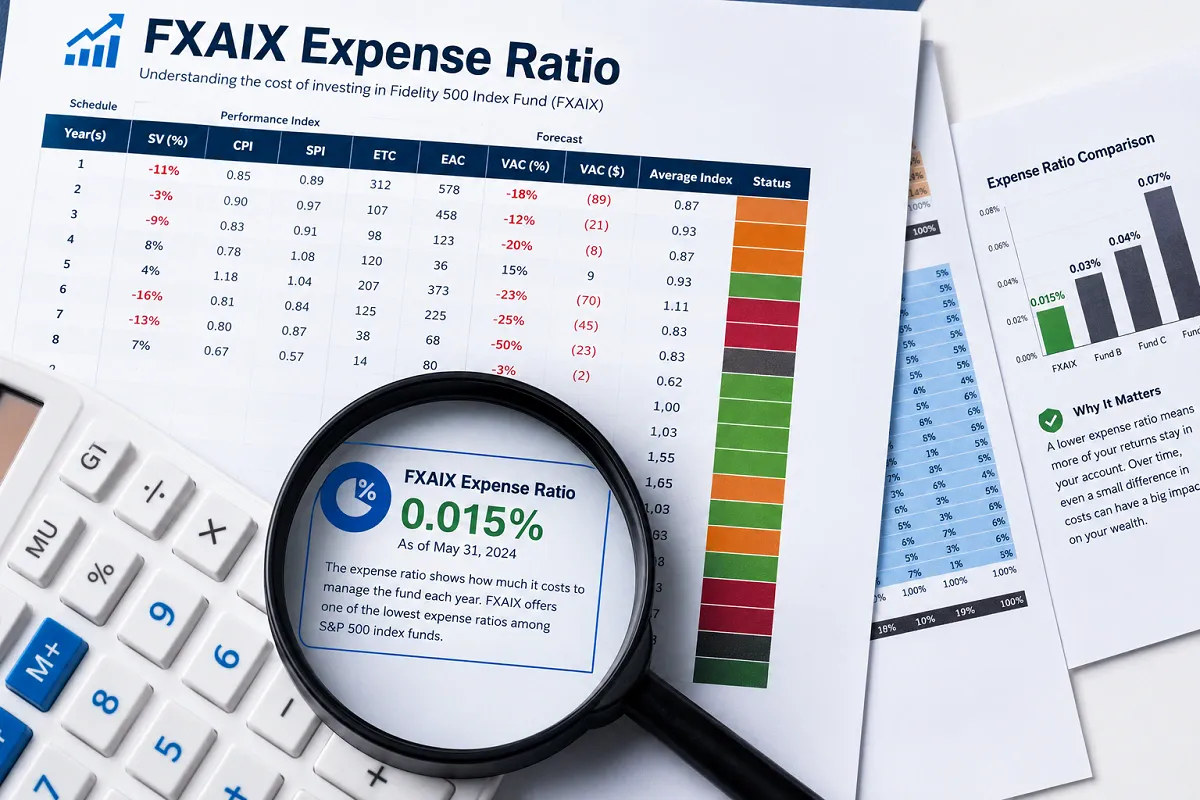
Thinking about investing in the S&P 500? You probably want to know first: how much does it cost? The answer is simple. The FXAIX fee is just 0.015 percent, making it one of the cheapest funds on the market. In layman’s terms, this means that if you are investing $10,000, you will only pay 1.5 percent in fees throughout the year, which is negligible. But the real questions start with this question. How are these fees paid? Is it really cheaper than VOO and SPY? And does the difference between 0.015% and 0.03% mean anything in the long run? In this article, we will understand from every angle. We will also learn how to pay fees, compare them with the most popular alternative funds, and learn the factors that should definitely be included in your decision, in addition to fees.
Note: This article is for educational purposes only and should not be considered advice. Talk to a financial advisor before you invest.
What is the Expense Ratio?
The expense ratio is the yearly fee a mutual fund or ETF charges, shown as a percentage of your investment. It includes:
- Management fees, the company that runs the fund.
- Administrative expenses, recordkeeping, custodian, and transfer agent fees.
- Legal and audit fees.
How do you pay these fees?
It is important to understand that there is no separate expense ratio bill, nor is any money deducted from your account. The fund takes this fee out of its value a little bit every day. This means that the returns you see are after the bill fee is deducted. This is why many investors pay this fee for years but never realize that it is negligible.
What is the expense ratio of FXAIX?
According to Fidelity, FXAIX’s official expense ratio is 0.015%. Some financial websites (such as some aggregators) round it up to 0.02%, but Fidelity’s own published number is 0.015%. For comparison: That’s about 98% lower than the average fee for funds in the Large Blend category.
What does 0.015% mean in practice?
This number is so small in percentage terms that it’s hard to estimate. Let’s look at it in dollars.
Example: Annual fees for various investors
Annual investment fee (0.015%)
| $1,000 | $0.15 |
| $10,000 | $1.50 |
| $100,000 | $15 |
| $500,000 | $75 |
| $1,000,000 | $150 |
Yes, even a million-dollar investment costs just $150 per year. This is a great example of how the fee war in the index fund industry has gone to the extreme for investors.
FXAIX Expense Ratio comparison with popular funds
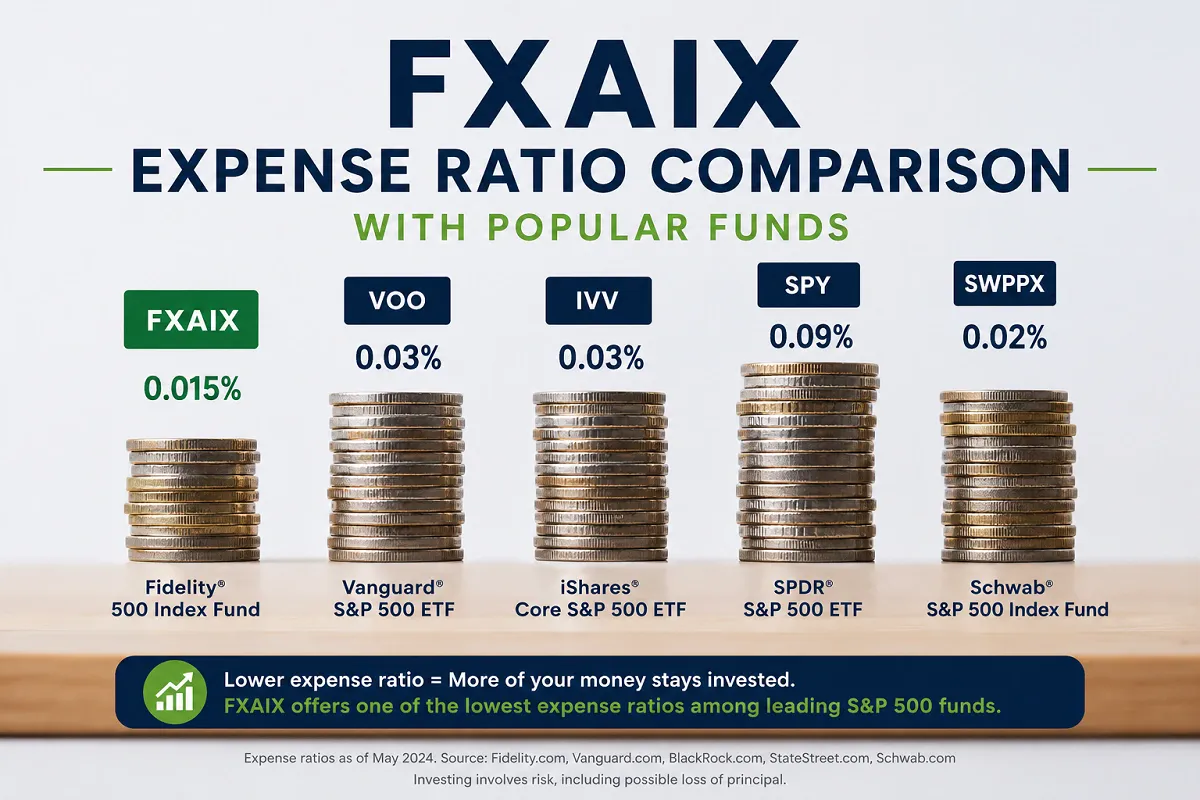
The importance of FXAIX comes to light when we look at it alongside other S&P 500 funds.
FXAIX vs VOO
VOO (Vanguard S&P 500 ETF) is perhaps FXAIX’s most important competitor. VOO has an expense ratio of 0.03%, higher than FXAIX. But the practical difference is very small: on $100,000, the annual difference is only $15. The real difference is in structure: VOO is an ETF that trades during market hours and can lose money at any time, while FXAIX is a mutual fund that trades at NAV once a day, 24 hours a day, after the market closes.
FXAIX vs SPY
SPY (SPDR S&P 500 ETF Trust) is the world’s oldest U.S. ETF, but its expense ratio is just 0.09%, six times higher than FXAIX. SPY’s real value is its liquidity, which is of great importance to day traders and options traders. For the long-term buy-and-hold investor, SPY’s additional fees are not particularly justified.
FXAIX vs FNILX
Fidelity’s own FNILX (Fidelity ZERO Large Cap Index Fund) comes with a 0.00% fee, that’s absolutely free. So why FXAIX? The difference is that FNILX doesn’t officially track the S&P 500 but rather tracks Fidelity’s own proprietary index (to save on licensing fees for using the S&P 500 name). The results are almost identical, but FNILX is only available in Fidelity accounts and cannot be transferred to another broker. The difference between 0.015% and 0.00% is so small that it shouldn’t be a deciding factor for most investors.
Comparison at a Glance
Fund Type Expense Ratio Annual Fees on $10,000
FXAIX Mutual Fund 0.015% $1.50
FNILX Mutual Fund 0.00% $0
VOO ETF 0.03% $3
IVV ETF 0.03% $3
SPY ETF 0.09% $9
The impact of a low expense ratio in the long run
The relationship between compounding and fees
The real downside of fees is not the annual deduction, but the lost compounding that could have been generated by the deduction. Suppose two investors invest $100,000 for 30 years and the market returns about 10% annually:
- 0.015% fee fund (like FXAIX): On average, the entire market return in your pocket
- 1% fee active fund: Millions of rupees in fees and lost compounding over 30 years
The difference between low-fee funds like FXAIX and VOO (0.015% vs. 0.03%) remains almost negligible even over 30 years, around a few hundred dollars. The real lesson is that the difference between a low-fee index fund and a high-fee active fund can be life-changing, while the choice of the two cheapest index funds should be based mostly on convenience and platform considerations.
Is it enough to understand the expense ratio alone?
No. The expense ratio is one of the most important factors, but not the only one. Also consider these factors when choosing a fund:
Key factors
- Tracking Error: Does the fund track its index accurately? How strong has FXAIX’s historical track record been?
- Availability: Is FXAIX primarily purchased as a mutual fund through a Fidelity account? If you’re with another broker, might VOO or IVV be a more practical choice?
- Minimum investment: There is no minimum investment in FXAIX; you can start with just a few dollars and buy in exact dollar amounts, which is much easier and more important for dollar-cost averaging.
- Tax aspects: ETFs are generally more tax-efficient than mutual funds in taxable accounts. In retirement accounts (such as a 401(k) or IRA), the difference becomes less clear.
- Your country and access: FXAIX is a U.S. mutual fund. Direct access from Pakistan or other countries may be limited, so it is very important to verify your country’s rules and regulations and available platforms.
Final Words
FXAIX’s expense ratio, 0.015%, is a benchmark for low costs in the world of index investing. The annual fee of just $1.50 on $10,000 is practically nonexistent, which is why FXAIX is so popular with investors. FXAIX charges half the fees compared to VOO and IVV, and it’s completely free compared to SPY.
But remember: When fees get this low, the real decision isn’t about the fees, but about convenience, platform, tax situation, and your overall investment strategy. If you use Fidelity and want to invest in the S&P 500 for the long term, FXAIX is a very strong, low-cost choice that makes a lot of sense. Be sure to read the fund’s latest prospectus and consult with your financial advisor before making any final decisions.
FAQs:
Q: What is FXAIX’s expense ratio?
According to Fidelity, FXAIX’s expense ratio is 0.015%. This means that for every $10,000 invested, you pay only $1.50 in fees annually. Some websites round this up to 0.02%, which is incorrect.
Q: Is FXAIX’s expense ratio lower than VOO’s?
Yes. FXAIX’s fee is 0.015%, while VOO’s is 0.03%, half the FXAIX fee. However, the difference in dollars seems very small: just $15 per year on $100,000.
Q: How do I get charged FXAIX fees?
There are no separate bills or deductions. The fees are automatically adjusted daily to the fund’s NAV, so the return you see is after fees are deducted.
Q: Why should I buy FXAIX if FNILX has zero fees?
FNILX is indeed a 0.00% fee fund, but it doesn’t track the official S&P 500 index and is limited to Fidelity accounts; it can’t be transferred to another broker. FXAIX tracks the actual S&P 500 and has a virtually nonexistent 0.015% fee.
Q: Is there a minimum investment in FXAIX?
No. FXAIX has no minimum investment requirement, and you can buy in exact dollar amounts, which is great for regular monthly investing (dollar-cost averaging).
Q: Can the expense ratio change over time?
Yes, fund companies can change the expense ratio, although the overall graph of index fund fees has been consistently downward over the past two decades. Always check Fidelity’s official website or fund prospectus for the most up-to-date fees.
For any suggestions or changes, please get in touch with us.