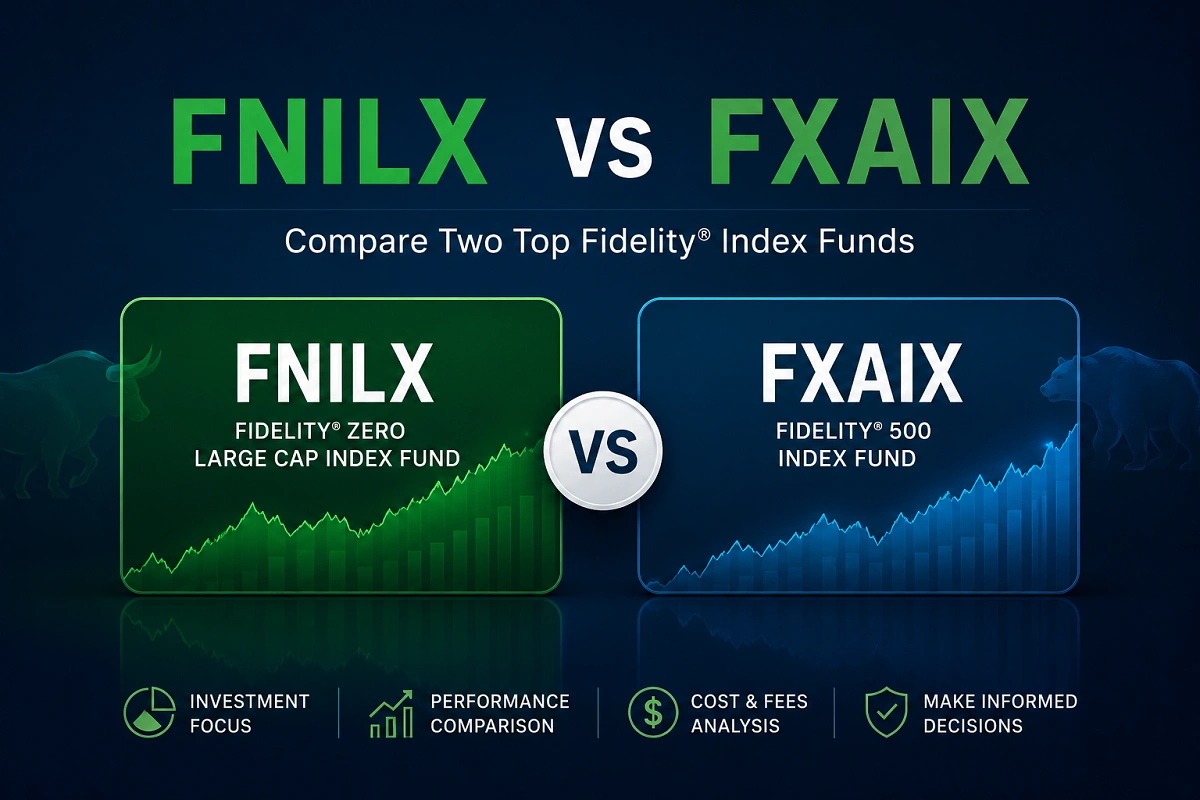
If you want to invest in the US stock market through Fidelity, there are two funds that you will come across repeatedly: FNILX and FXAIX. Both of these funds invest in the largest companies in the US, both have almost no fees, and both have almost the same and good performance. What’s the difference, and why? And which fund should you buy or invest in?
The simpler this question seems, the more interesting the answer is. The truth is that the real decision between FNILX and FXAIX is not just about fees but also about account type, dividend frequency, taxes, and portability (i.e., the ease of transferring the fund to another broker). In this article, we will discuss both funds in detail: expense ratio, historical returns, dividends, tax efficiency, and one major flaw that most people overlook about FNILX. Ultimately, you will be able to make the best decision for yourself as to which fund is best for you.
Note: This article is for education and information only. It is not financial advice. It is very important to consult a qualified financial advisor before making any investment.
What is FNILX?
FNILX’s full name is Fidelity ZERO Large Cap Index Fund. This fund was launched in 2018 and, as its name suggests, its biggest advantage is its 0.00% expense ratio, meaning you don’t have to pay any annual fees to own the fund. If it does, it’s negligible. FNILX invests in about 500 of the largest companies in the United States, including Apple, Microsoft, NVIDIA, and Amazon. As of March 2026, the fund had about $16.5 billion in assets.
FNILX’s “Zero Fee” Secret
FNILX does not use the same list of stocks as the S&P 500. This is an important point to understand. This is because Fidelity pays S&P Global a fee to use the S&P 500 name. To avoid this fee, Fidelity created its own index called the Fidelity U.S. Large Cap Index. In practice, this index is almost the same as the S&P 500, about 99% similar, but it is not officially the S&P 500 itself.
FNILX’s biggest flaw: Portability
This is a point that is often overlooked in comparisons. FNILX can only be bought and kept in a Fidelity account. If you want to move your account to another broker in the future (such as Vanguard or Charles Schwab), you will have to sell FNILX first. If the fund is in a taxable account, the sale may result in capital gains taxes, which is not good.
What is FXAIX?
FXAIX’s full name is Fidelity 500 Index Fund. The fund was launched in 1988, meaning it has a track record of over 35 years. It is one of the largest index funds in the world. As of early 2026, its assets had exceeded $739 billion.
FXAIX follows the S&P 500 Index. This index includes the 500 biggest public companies in the United States. Together, these companies make up about 80% of the total value of the U.S. stock market.
FXAIX Fees and Ratings
FXAIX charges an expense ratio of only 0.015%, which is very low. This means that if you have $100,000 invested, the annual fee will be just $15. For comparison, fees for common funds on the market range from 0.3% to 0.9%, and popular ETFs like VOO have fees as low as 0.03%, making FXAIX the most important and affordable of them all. Morningstar has given FXAIX a 5-star rating, which is important for FXAIX.
FNILX vs FXAIX: Detailed Comparison
Expense Ratio (Fees)
Aspect FNILX FXAIX
Expense Ratio 0.00% 0.015%
Index Fidelity U.S. Large Cap Index S&P 500
Start 2018 1988
Assets (2026) ~$16.5 billion ~$739 billion
Dividends Once a Year Quarterly
Portability Only Fidelity Transferable to any broker
Minimum Investment $0 $0
FNILX wins in terms of fees, but how big is the difference? FXAIX has an annual fee of just $15 on $100,000. Even after twenty years of compounding, the difference is only a few hundred dollars. That’s why many experts consider this zero-fee approach more of a marketing ploy than a real benefit.
Historical Performance and Returns
The returns of both funds are almost identical, as both have more than 99% similarity in their holdings, and their correlation is around 1.00, which is the best performance.
- In 2025, FXAIX gained 17.62%, and FNILX gained 17.56%. The two funds performed almost the same, only 0.06% apart.
- Five-Year Average: FXAIX returned about 13.1% per annum, while FNILX returned about 12.8% per annum.
- Max Drawdown: FXAIX -33.79% and FNILX -33.76%, almost the same; the difference is almost negligible.
Interestingly, despite having zero fees, FNILX has performed marginally worse than FXAIX. Possible reasons for this include the difference in the index and the tracking method. The lesson is that fees alone are not enough to make a decision. It is very important to consult a financial advisor.
Dividends: An important but overlooked difference
- FXAIX pays dividends quarterly (4 times a year), and its current dividend yield is about 1.06%.
- FNILX pays dividends only once a year, and its yield is about 0.94%. The difference in dividends is also very small.
If you reinvest the dividends, FXAIX’s quarterly distributions give you more compounding opportunities throughout the year. Even this small difference can become meaningful in the long run.
Tax Efficiency: Which Fund to Hold in Which Account?
This is the most practical aspect of the FNILX vs FXAIX decision:
Tax-advantaged accounts (Roth IRA, 401(k), etc.)
These accounts do not have capital gains tax issues, so the portability flaw of FNILX becomes irrelevant. Here, FNILX is a reasonable choice because you take full advantage of the zero fees.
Taxable Brokerage Accounts
FXAIX is generally considered the better choice. It’s simple. If you ever want to change brokers, you will have to sell FNILX, compared to a fund like FXAIX, which may be subject to taxes. Many financial planning sources also recommend that FNILX be limited to tax-advantaged accounts, and this advice from a financial advisor is very good and important.
Should you hold both funds together?
Some investors buy both funds, but this strategy is not very profitable. Since the correlation between the two is 1.00, holding both does not add any diversification; you are essentially doubling your position in the same market segment. It is generally more effective to choose one fund. It is important to consult a financial advisor for further advice.
Note for Pakistani and Overseas Investors
Both FNILX and FXAIX are Fidelity’s US mutual funds, so direct access to them is generally available to those with US brokerage accounts. If you want to invest from Pakistan or another country, an alternative option if you don’t have a Fidelity account is S&P 500 ETFs like VOO or IVV, which are available through international brokers. Be sure to consult a local expert to understand your country’s tax laws and exchange restrictions.
Which fund is best for whom?
Choose FNILX if:
- Your account is at Fidelity, and you plan to stay there for the long term.
- You are investing in a tax-advantaged account like a Roth IRA or 401(k).
- You want to save every basis point possible.
Choose FXAIX if:
- You are investing in a taxable account.
- You want the “official” S&P 500 index and a 35+ year track record.
- You want quarterly dividends and the freedom to switch brokers in the future.
Final Words
The FNILX vs FXAIX comparison is one of the few debates in the world of personal finance where both answers are correct. Both funds are extremely low-cost, high-quality, and have nearly identical performance. The real decision isn’t about fees, but about your account type: Take advantage of FNILX’s zero fees in a tax-advantaged account, while FXAIX’s portability and quarterly dividends in a taxable account offer more practical benefits. The difference between the two funds is negligible. The most important thing is to keep investing regularly, because over the long term, a 0.015% fee difference is completely insignificant compared to your consistency. Remember, this article is not financial advice; it’s important to consult a qualified financial advisor before making a final decision.
FAQs:
Q: Are FNILX and FXAIX the same?
Almost, but not quite. Both invest in the 500 largest U.S. companies and have a correlation of 1.00, but FXAIX tracks the official S&P 500 while FNILX follows Fidelity’s own index. There are also differences in dividend frequency and portability, but they are negligible.
Q: Why does FNILX have zero fees?
Fidelity offers FNILX as an introductory product to attract new customers. By not using the S&P 500 name, it also saves on licensing fees, which makes a zero expense ratio possible.
Q: Can FNILX be transferred to another broker?
No. FNILX can only be held in Fidelity accounts. If you change brokers, you will have to sell the fund, which may incur capital gains taxes in a taxable account. FXAIX does not have this restriction and has shown excellent performance.
Q: Which has a higher return, FNILX or FXAIX?
Historically, FXAIX has had a slightly higher return. In 2025, FXAIX returned 17.62%, and FNILX returned 17.56%. Even on a five-year basis, FXAIX has outperformed by about 0.3% annually, despite its higher fees. The difference is negligible.
Q: Is FXAIX better than VOO?
In terms of fees, FXAIX (0.015%) is cheaper than VOO (0.03%), but VOO is an ETF that can be traded at any broker. FXAIX is generally better for Fidelity account holders; VOO is a more practical choice for customers of other brokers.
Q: Should I buy both FNILX and FXAIX?
Generally, no. Both funds invest in roughly the same companies, so holding both does not increase diversification. Choosing a fund according to your account type is a more effective strategy. Furthermore, it is important to consult a financial advisor.
For any suggestions or changes, please contact us.