
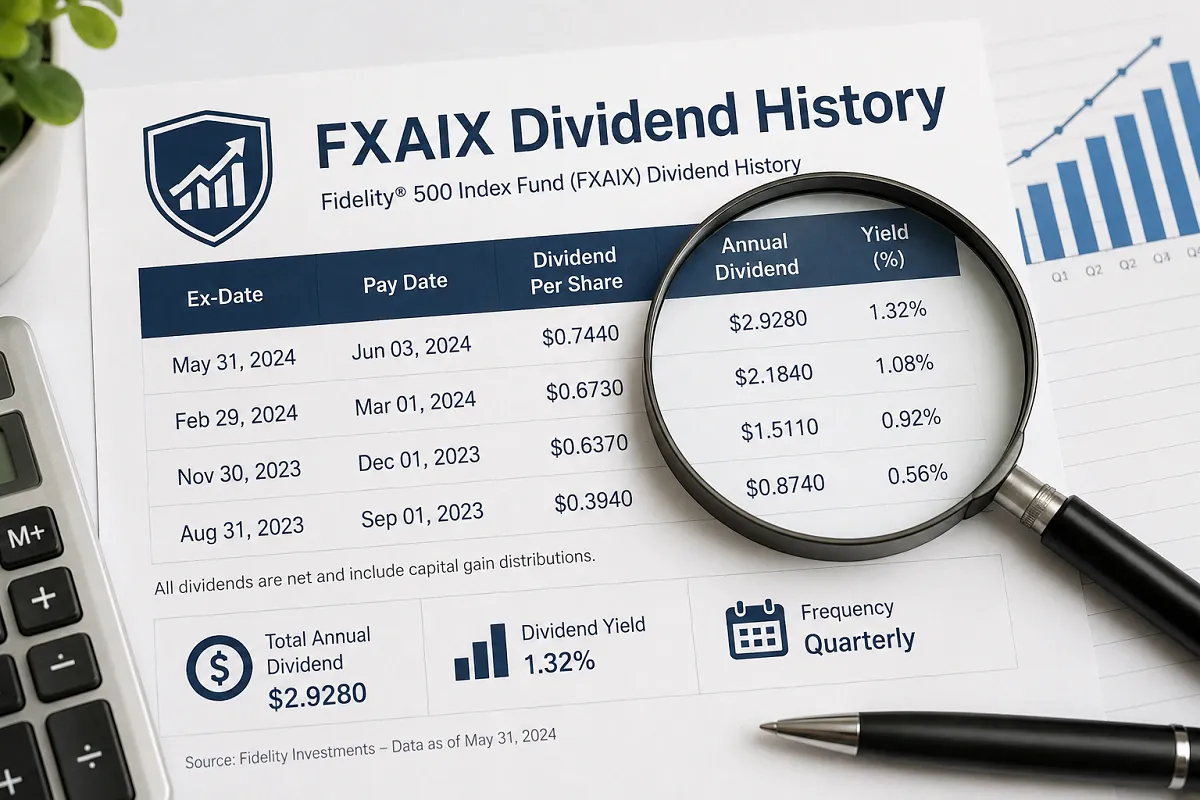
If you invest in the US stock market through index funds, the name FXAIX, or Fidelity 500 Index Fund, will not be new to you. This fund follows the S&P 500 Index and is one of the biggest and cheapest index funds in the world. But one question investors often ask is: What does the FXAIX dividend history tell you? How often does this fund pay dividends, how much has been paid per share in the past, what is the dividend yield, and is it safe to buy this fund for “income”?
In this article, we will review FXAIX’s actual quarterly dividend payout history (from 2021 to 2026), annual dividend per share, current yield, ex-dividend and pay date system, dividend reinvestment (DRIP) strategy, and key tax considerations for non-US investors. All figures come from public financial data, published by S&P Global Market Intelligence. Where something is expected rather than confirmed, it is clearly marked.
Key Facts at a Glance
- Fund Name: Fidelity 500 Index Fund (Ticker: FXAIX)
- Type: Mutual Fund (not an ETF), Buys and sells at NAV only once a day
- Benchmark: S&P 500 Index
- Expense Ratio: About 0.015%, one of the lowest fees in the industry
- Dividend Payment: Quarterly (four times a year)
- Current Dividend Yield: Between about 1.03% and 1.07% (as of July 2026)
- Annual Dividend (trailing twelve months): About $2.72 per share
FXAIX Dividend History: Quarterly Payment Records
The table below shows FXAIX’s quarterly distributions for recent years. Keep in mind that mutual fund distributions can incorporate capital gains distributions along with dividends, so December’s payouts often appear higher than those of other quarters.
| Ex-Dividend Date | Amount Per Share | Pay Date |
| Apr 10, 2026 | $0.668 | Apr 13, 2026 |
| Dec 19, 2025 | $0.725 | Dec 22, 2025 |
| Oct 3, 2025 | $0.672 | Oct 6, 2025 |
| Jul 11, 2025 | $0.654 | Jul 14, 2025 |
| Apr 4, 2025 | $0.597 | Apr 7, 2025 |
| Dec 20, 2024 | $0.723 | Dec 23, 2024 |
| Oct 4, 2024 | $0.642 | Oct 7, 2024 |
| Jul 5, 2024 | $0.625 | Jul 8, 2024 |
| Apr 5, 2024 | $0.553 | Apr 8, 2024 |
| Dec 15, 2023 | $0.702 | Dec 18, 2023 |
| Oct 6, 2023 | $0.559 | Oct 9, 2023 |
| Jul 7, 2023 | $0.602 | Jul 10, 2023 |
| Apr 5, 2023 | $0.538 | Apr 6, 2023 |
| Dec 16, 2022 | $0.636 | Dec 19, 2022 |
| Oct 7, 2022 | $0.581 | Oct 10, 2022 |
| Jul 1, 2022 | $0.577 | Jul 5, 2022 |
| Apr 8, 2022 | $0.462 | Apr 11, 2022 |
| Dec 10, 2021 | $0.583 | Dec 13, 2021 |
| Oct 1, 2021 | $0.527 | Oct 4, 2021 |
| Jul 2, 2021 | $0.496 | Jul 6, 2021 |
Annual Total Dividend Per Share
If we add up all four quarterly payments for each year, the picture becomes clearer:
Year Total Dividend Per Share Annual Increase
2022 $2.256 —
2023 $2.401 +6.4%
2024 $2.543 +5.9%
2025 $2.648 +4.1%
2026 (so far) $0.668 (April) Released
Dividend Growth Trend
From 2022 to 2025, FXAIX’s annual distribution increased from $2.256 to $2.648, an increase of about 17% over three years (an average of five to six % per year). The increase is no misadventure: When companies in the S&P 500 increase their dividends, the fund’s allocation automatically increases as well. Nevertheless, the amounts are not completely smooth; each quarterly payment can be higher or lower depending on market conditions, the dividend schedule of the companies in the fund, and capital gains. For example, only $0.462 was paid in April 2022, compared to $0.725 in December 2025.
When does FXAIX pay dividends? Payment schedule
FXAIX pays dividends four times a year, in April, July, October, and December. Capital gains are usually paid out at the end of the year. The dates are not the same every year, so investors should check Fidelity’s official distribution schedule page.
What Ex-Dividend, Record, and Pay Dates mean
- Ex-Dividend Date: You must own shares before this date, or you will not be entitled to the distribution.
- Record Date: The fund looks at a list of its registered shareholders. In mutual funds, this usually happens with the ex-date.
- Pay Date: The original amount is credited to your account, or (if reinvestment is on) new shares are purchased.
- An important technical point: On the ex-date, the fund’s NAV is reduced by the amount of the distribution. That is, a dividend is not “free money”, it is a portion of your own investment transferred to you in cash.
Next Expected Payment (July 2026)
According to public data providers, FXAIX’s next quarterly distribution ex-date is expected to be around July 13, 2026, and the payment is anticipated to be around July 14, 2026, with an estimated payout of around $0.65 per share. This is an estimate, not a final announcement; the fund itself declares the final amount.
How to Understand the FXAIX Dividend Yield
FXAIX’s onward dividend yield as of July 2026 is around 1.02% to 1.07%, and the price per share is around $257. That means a $10,000 investment is anticipated to receive a cash distribution of around $100 to $107 per year.
Why is the yield so low?
FXAIX is not a dividend fund. It is a growth and income index fund. The S&P 500 is currently heavily weighted toward technology companies that reinvest a large portion of their earnings rather than paying out dividends or share buybacks. That’s why FXAIX’s yield is lower than that of dividend-focused funds (such as high-dividend or REIT funds). If your goal is just regular cash income, FXAIX alone is not a good choice for that intent.
The Difference Between Dividend and Capital Gain Distributions
Mutual fund distributions can be made up of two parts:
(1) dividend income received from companies.
(2) capital gains earned from buying and selling shares within the fund. Index funds have low inversion, so capital gains distributions in FXAIX are relatively limited, but when they do occur, they are usually in December. That’s why December numbers appear larger on data sites.
Dividend Reinvestment Plan (DRIP) and the Power of Compounding
Most long-term investors instinctively reinvest FXAIX dividends into the fund rather than taking cash. Fidelity offers this feature for free, and even fractional shares can be purchased. The advantage is that each quarter your share count increases, and the next dividend is paid on those increased shares; that’s compounding. Traditionally, an important portion of the S&P 500’s total return has come from these reinvested dividends, not just price recognition.
One important caveat, however: Even if reinvested in a taxable account, dividends are still subject to tax in the same year, even if you don’t withdraw a single dollar.
Taxes and Important Notes for Non-U.S. Investors
- For U.S. investors: Most distributions fall into the category of “competent dividends,” which are taxed at a lower rate than ordinary income. Details are provided on Form 1099-DIV.
- For non-U.S. (non-resident alien) investors: S. dividends are generally subject to a 30% withholding tax, which may be reduced in the case of a tax treaty. The W-8BEN form is for this intent.
- A practical fact: S. mutual funds (including FXAIX) are not directly available to residents of many countries, because the fund’s prospectus and broker policy do not allow it. Investors based in Pakistan or other countries typically look for alternatives through S&P 500-based ETFs (e.g., VOO or IVV) or local/international brokers. Be sure to check with your broker and local laws (including State Bank of India’s remittance limits) before investing.
What to Conclude from Dividend History, and What Not to
FXAIX’s dividend history paints a positive picture: regular quarterly payments, steadily increasing amounts, and very low fees, resulting in more assets in the hands of investors. But honesty demands that a few restrictions be made clear:
- Past payments are no guarantee of future returns. Companies can cut dividends in a downturn (as happened in many sectors in 2020).
- The yield is around 1% — it can’t be the sole source of retirement income.
- The NAV is reduced by the same amount when dividends are paid; it’s not additional profit, but a form of profit.
- The real attraction of FXAIX is low fees and long-term market-beating growth; the dividend is an added benefit, not the main reason.
Final Words
The FXAIX dividend history tells us a simple but powerful story: a very low-cost index fund that transfers a portion of the profits of the 500 largest U.S. companies to its investors every quarter, and whose annual distribution has increased from $2.256 per share in 2022 to $2.648 per share in 2025. The current yield is about 1%, low, but steady and growing.
If you’re a long-term investor, the most productive strategy has generally been to reinvest dividends and let compounding do the work, preferably in a tax-advantaged account. But remember: FXAIX is not bought as an income fund, but as cheap, broad market exposure; the dividend is a gentle breeze on this journey, not the engine.
FAQs:
Q: Does FXAIX pay a dividend?
A: Yes. FXAIX pays dividends four times a year (quarterly), usually in April, July, October, and December. The total distribution over the past twelve months has been approximately $2.72 per share.
Q: What is FXAIX’s dividend yield?
A: As of July 2026, FXAIX’s yield is approximately 1.02% to 1.07%. It vacillates with the price: the yield decreases as the price rises and increases as the price falls.
Q: When is FXAIX’s next ex-dividend date?
A: The last verified ex-date was April 10, 2026 ($0.668 per share, payable April 13, 2026). The next dividend is anticipated to be paid in mid-July 2026. See Fidelity’s official website for the final date and amount.
Q: How much did FXAIX pay in 2025?
A: The four quarterly payments in 2025 combined to approximately $2.65 per share ($0.597 + $0.654 + $0.672 + $0.725).
Q: Does FXAIX’s dividend reinvest automatically?
A: This depends on your settings. You can turn dividend reinvestment on or off in your Fidelity account. The default is often reinvestment, but be sure to confirm this when opening your account.
Q: Is FXAIX a good fund for dividend income?
A: If your goal is regular cash income, a yield of about 1% is not enough. FXAIX is primarily suited for long-term growth and market exposure; for pure income, investors typically look to dividend-focused funds, bonds, or a blended portfolio.
Important Disclaimer
This article is for educational and informational purposes only and should not be analyzed as investment advice. All data provided herein is from public financial data sources as of July 12, 2026, and may change over time; always refer to Fidelity’s official fund page and prospectus for final confirmation. Investing involves the risk of loss of principal. Please consult a qualified financial advisor before making any decisions.
For any suggestions or changes, please contact us.